Resources Hub


Margin Starts at the Model: The Case for Automated Should Cost for DFM

Mark Rushton
— September 8, 2026
Listen to this Article
1×
00:00
00:00
Key Takeaways:
- Cost drivers are decided at the design stage, not in production. Roughly 80% of a product’s cost is locked in before it ever reaches the shop floor. Geometry, tolerances, materials, and process selection are the real cost drivers. And catching them late in product development doesn’t enable cost reduction. It just makes changes exponentially more expensive
- Automated should cost for DFM turns cost reduction into a design-time activity.
When should cost analysis runs continuously inside CAD, design engineers can act on cost drivers while they still have degrees of freedom. That’s when cost reduction is cheapest, fastest, and most impactful to the final margins - Production volume changes the math, and your cost model needs to keep up.
A design optimized for low-volume machining can be the wrong choice at scale, where casting or injection molding significantly shifts the cost equation. aPriori’s digital factory simulations account for production volume in every estimate, so process and sourcing decisions reflect the volumes you’ll actually run
The Full Article
Why “Cost-at-the-End” Is the Wrong Way to Design
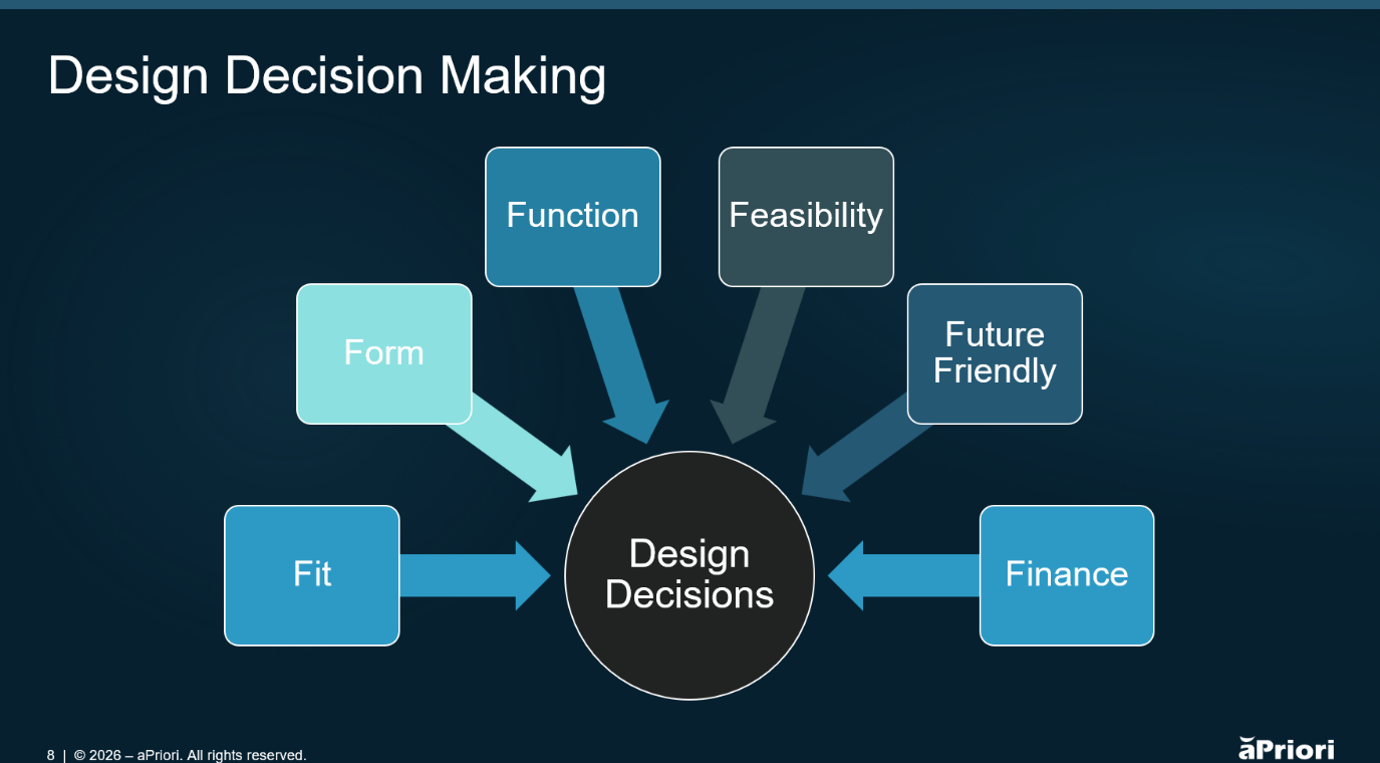
When a design engineer finishes a model, cost is rarely the first question on their mind. They’re focused on function, form, and fit. Cost is determined later, when procurement runs the RFQ, the supplier sends a quote, and finance runs the bill of materials (BOM) review.
It’s a logical workflow. But a very expensive one too.
Because by the time anyone asks, “What does this part cost to make?” roughly 80% of that cost is already locked in. The geometry is set. The tolerances are specified. The material is chosen. The manufacturing process is implied by the design. Every downstream decision, from which supplier and region to choose to which process to use, is now constrained by choices the design engineer made without regard to cost or context.
Cost feedback arrives after the decisions that drive cost have already been made.
This is the core challenge of Design for Manufacturability. It’s not because engineers design expensive parts. It’s that critical cost feedback arrives long after these financial decisions are made.
The Problem Isn’t the Design: It’s the Timing
Most product teams treat design for manufacturing (DFM) as a checklist you run through before releasing drawings. Manufacturing reviews the model, flags any issues, engineering makes some adjustments, and everyone moves on. The process seems diligent. However, in practice, it’s just damage control.
By the time a DFM review occurs, the design has already been through multiple iterations. The program schedule is locked. The tooling vendor has been briefed. Engineering change orders (ECOs) at the design validation stage cost, on average, more than 10X as much with each successive stage of product development. That multiplier shows up in ECO hours, retooling costs, delayed launches, and eroded margins.
And it happens over and over on nearly every product, across most industries.
The question isn’t whether your team leverages DFM. It’s whether DFM happens early enough to matter.
How Cost Blind Spots Compound Across the Development Cycle
The timing problem doesn’t stay contained. It propagates in a few ways:
- Rework becomes the default. When cost issues surface late, ECOs become a standard part of the development process rather than an exception. Each ECO adds two to six weeks of rework. A typical program absorbs several ECO cycles before launch.
- Supplier quotes lose their leverage. Cost engineers trying to validate supplier quotes are working without a baseline. Without a credible should cost model grounded in the actual geometry, process, and regional inputs, they have no analytical foundation to push back on quotes. Negotiation becomes intuition, and that’s expensive.
- Sourcing decisions miss the full picture. A part optimized for domestic machining may cost 35% more than a design adjusted for low-cost region casting. But design engineers rarely see multi-region cost comparisons while they’re still in CAD. By the time sourcing evaluates regions, the design is fixed.
- Design and cost teams work in parallel, not collaboratively. Design engineers work in CAD. Cost engineers work in spreadsheets. The two systems don’t talk. Every revision the design team makes resets the cost model that the cost engineer just built. This isn’t a process failure. It’s a systems failure.
The cumulative effect? Products that miss cost targets at launch. Margins that fall short from day one. Development teams caught in reactive firefighting rather than proactive design.
What Good Looks Like: Cost as a Design Input, Not a Design Output
The teams that consistently hit cost targets share a common discipline. They treat cost as a real-time design parameter, not a post-design audit.
This isn’t a philosophical shift. It’s a tooling shift. When engineers have access to cost estimates grounded in actual manufacturing process models that also update as they design, rather than historical averages or rule-of-thumb spreadsheets, the entire dynamic changes.
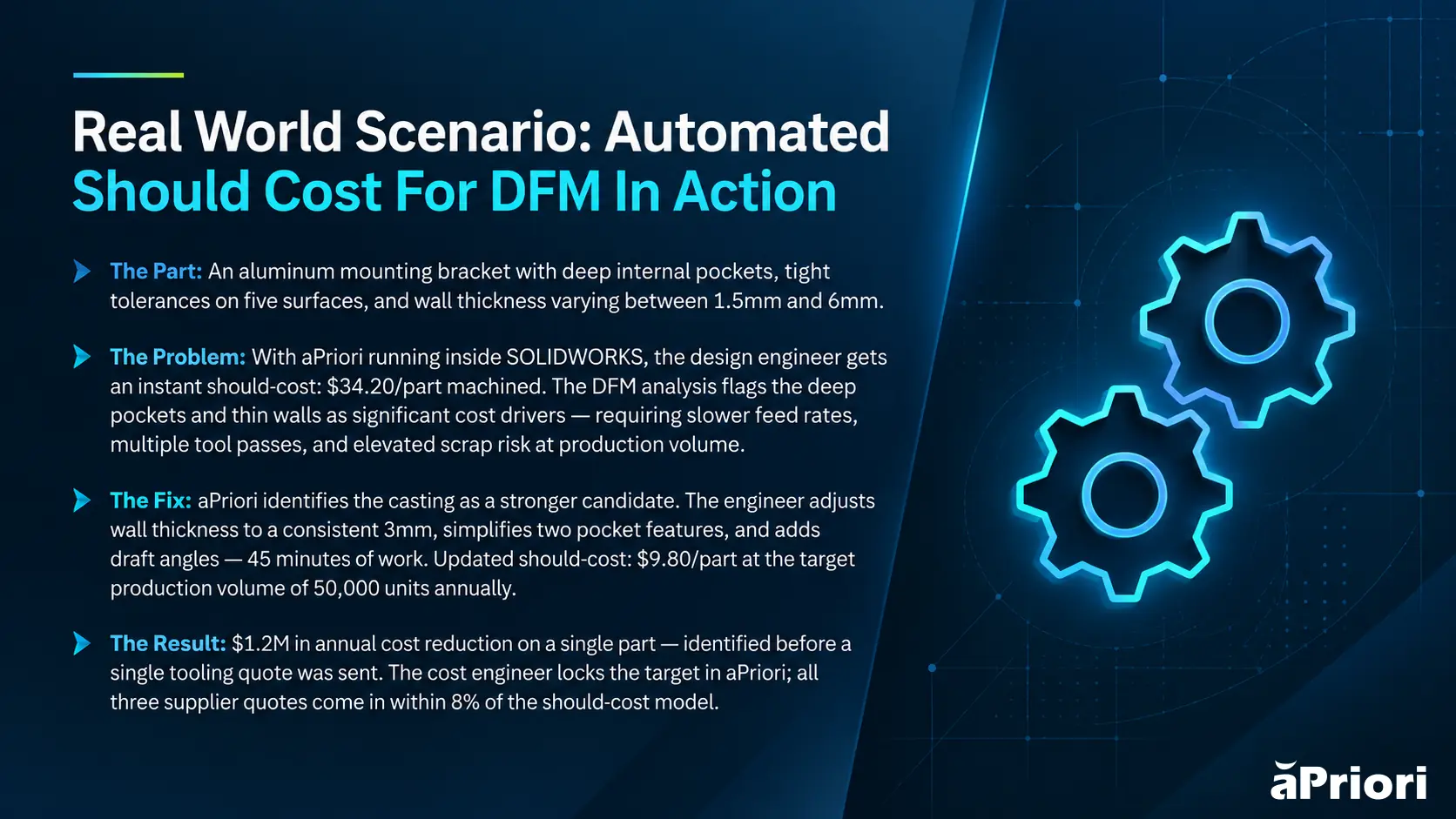
A design engineer who can see that increasing a wall thickness by 1.5mm adds $4.20 per part makes a different decision than one who finds out six weeks later in a DFM review. They don’t need to be cost engineers. They just need the signal early enough to act on it.
This is where aPriori changes the equation.
How aPriori Closes The DFM Cost Gap
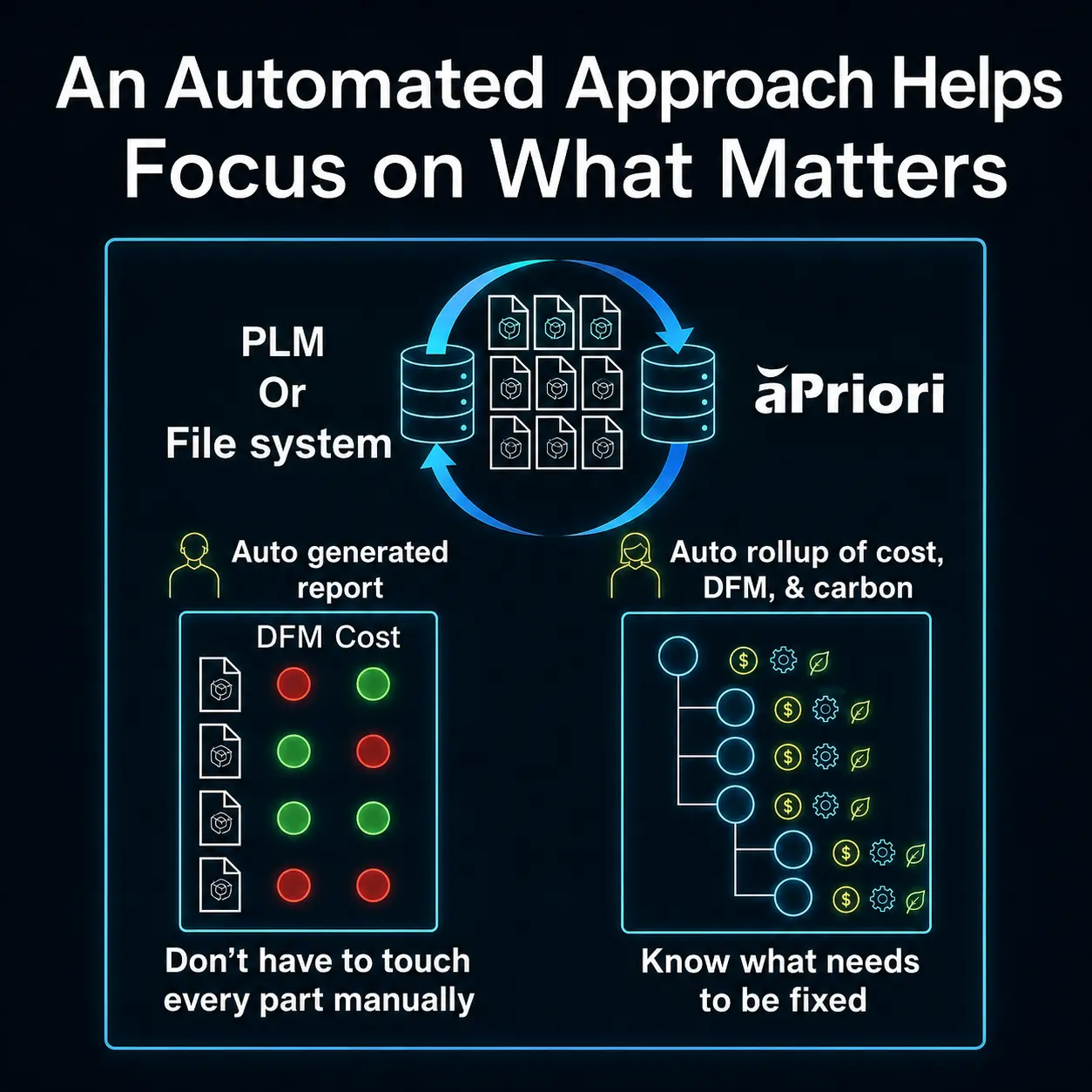
aPriori embeds manufacturing cost intelligence directly into the product development workflow. It is not a separate analysis step, but a continuous input. What’s more:
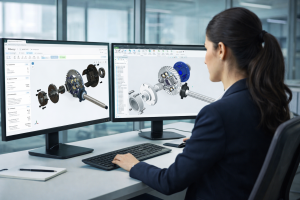
- Cost estimates update in real time inside CAD. As a design engineer works in their CAD, aPriori runs automated should cost analysis against 440+ manufacturing process models, including machining, casting, injection molding, sheet metal, and additive. Every geometry change triggers an updated cost estimate.
- DFM issues are flagged with context. aPriori explains why a feature is costly, which processes are incompatible with it, and what a lower-cost alternative might look like. Design engineers get actionable guidance.
- Multi-region cost models support sourcing decisions at design time. Engineers can compare should cost across North America, Eastern Europe, and Southeast Asia, using digital factory simulations that account for regional overhead, labor rates, machine rates, and cycle times.
- A shared model keeps design and cost teams aligned. When a design changes, cost updates automatically. Cost engineers spend their time on analysis and negotiation instead of rebuilding models after every revision. Target costs flow upstream and are tracked continuously.
- Should cost reports put cost engineers in stronger negotiating positions. When a supplier quote arrives, cost engineers run the same part through aPriori and produce a detailed should cost breakdown, process by process, operation by operation. Outliers can be identified immediately.
The Benefits Teams Actually See
The outcome of closing the DFM cost gap is measurable. Teams using aPriori report:
- 10–20% reduction in product cost, driven by design changes made early enough to matter
- 30–50% fewer ECOs, since cost and DFM issues are resolved before they become program problems
- Faster time-to-market, with fewer late-stage surprises compressing development timelines
- Stronger supplier negotiations, backed by should cost models rather than instinct
- Better cross-functional alignment, due to the ability of design and cost teams to share a single source of truth
For design engineers, this means fewer late-stage fire drills and a shorter feedback loop between what they build and its cost. For cost engineers, it means more leverage, better data, and time spent on analysis rather than administrative model maintenance.
The Real DFM Problem Is Upstream
DFM has always been the right idea. The failure mode has been timing.
Cost reviews, DFM gates, and supplier quotes all have value. But when they happen after the design is essentially done, they’re optimizing at the margin. The decisions that determine 80% of a product’s cost, such as process selection, geometry, tolerances, and materials, are made by design engineers in CAD weeks or months before anyone runs a formal cost analysis.
Giving those engineers automated should cost for DFM doesn’t slow them down. It supports better decision-making and validates those decisions they’ve already made.
That’s not a manufacturing transformation. It’s a design tool upgrade. And the margin impact shows up in every subsequent product.




Get Speed & Profitability: Automating Cost Intelligence Across Product Development
Discover how integrating aPriori into your PLM puts real-time DFM and should costing in the hands of your engineers and procurement teams — transforming product development into a proactive process that launches faster and protects margin.Access The Webinar