Resources Hub


Engineering Cost Analysis Belongs at the Base of Your Stack, Not the Top

Mark Rushton
— June 18, 2026
Listen to this Article
1×
00:00
00:00
Key Takeaways:
- Cost is a survival condition, not a finishing touch. A product that can’t be manufactured at a competitive price isn’t a product; it’s an expensive idea
- The conventional design stack is built backward. Defaulting to “design first, cost last”, leading to costly redesigns and late-stage surprises
- Modern tools make the fix possible. Automated, geometry-driven cost and DFM analysis can now live inside the design workflow from day one, turning cost into a live design parameter
The Full Article
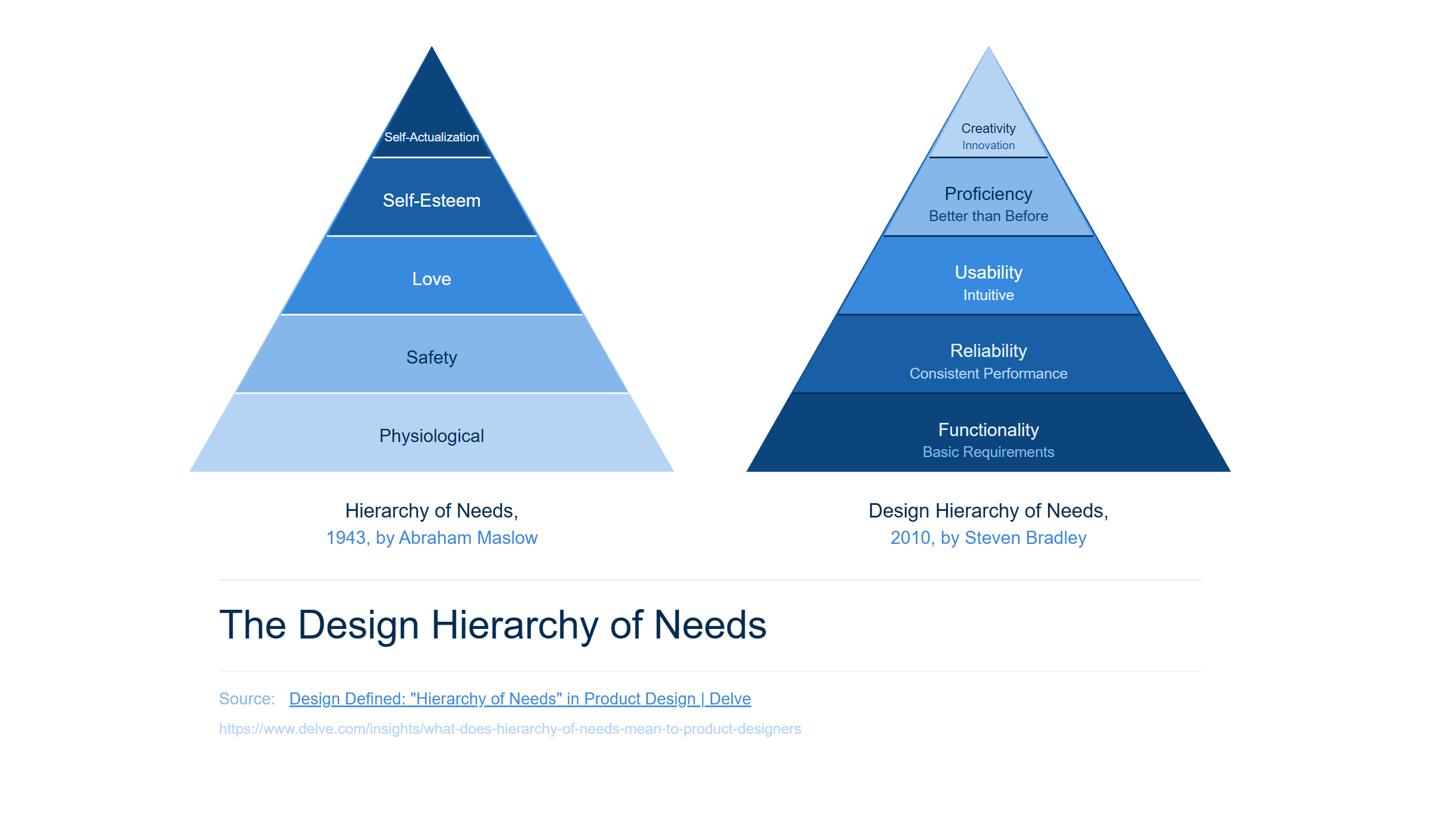
All humans have basic needs. In 1943, psychologist Abraham Maslow, developed the eponymic hierarchy, creating and prioritizing five levels of human needs. The foundation of his theory is that without psychological needs (food, shelter, water, clothing, and sleep) being met, humans cannot focus on or strive for higher needs or wants.
The other four, after psychological, and from lowest to highest are:
- Safety: Financial stability, personal security, and protection
- Love and Belongingness: Friendships, emotional and physical relationships, and a sense of belonging
- Esteem: Feelings of accomplishment, recognition, self-esteem, respect for others
- Self-Actualization: Personal growth and fulfillment, reaching potential
There can be variations in the order of progression. Some cultures may prioritize them differently or not include everything. More modern attitudes often emphasize pursuing many things simultaneously.
You may ask: What does that have to do with designing products? Both involve “nice to haves” and “need to haves”. And it’s important for design engineers to view product development in a similar way.
Product Design Has Hierarchy Needs Too
You might not realize it, but you’ve likely built your design engineering tech stack upside down.
Maslow never said physiological needs were more important than self-actualization. He said they come first. Why? Because nothing above them works without them.
The same theory applies to product design. Your cost tools belong at the foundation of your stack, not the top.
The Conventional Stack, Accepted As Wisdom
Ask a design engineering team to sketch their toolchain. You’ll see the same picture almost everywhere.
CAD sits at the foundation. It is the non-negotiable layer without which nothing else exists. Above it, data management. This includes PLM systems, version control, and the connective tissue that keeps complex assemblies from collapsing into chaos. Further up, simulation (Finite Element Analysis (FEA), Computational Fluid Dynamics (CFD) and similar) are the analytical layers that validate whether a design will hold together under real-world conditions.
Near the top, you’ll find cost estimation and DFM analysis. Perhaps above that, or maybe just below, a photorealistic rendering for customer and stakeholder presentations.
These tools are treated as refinements, or nice-to-haves. They are the things you reach for after the real work is done.
This hierarchy is so widely accepted that most organizations don’t question it. It simply reflects the order in which engineers naturally work: design first, validate second, cost last. The stack mirrors the process.
What Maslow Actually Said & What It Means Here
Maslow’s hierarchy is one of the most misread frameworks in management. People remember the pyramid shape and conclude that the top tier — self-actualization — is the goal, and the base tier is just basic housekeeping. But that misses the point entirely.
His argument wasn’t about importance. It was about dependency. You cannot pursue meaning, connection, or creative fulfillment if you’re cold, hungry, or unsafe. The base tier isn’t less important. It’s logically prior. Nothing above it functions until the base tier is met.
Cost and DFM are not a finishing touch on a design. They are survival conditions. A product that cannot be made at a competitive cost and ensure long-term profitability or healthy cash flow is not a product. It’s an expensive idea.
Apply this logic to the design engineering stack, and something becomes uncomfortable to admit: cost and DFM belong closer to the base, not the apex.
A design that is geometrically beautiful, structurally sound, and meticulously simulated is still a failed product if it cannot be manufactured at a viable price. Cost is not a refinement. It is a market-viability condition. Without it, the entire stack above is built on sand.
You don’t need to be familiar with Maslow to feel this force. If your product can’t survive in the market, nothing else about it matters. That’s not a philosophy argument. It’s business.
Why Cost Ended Up At The Top
The conventional stack didn’t emerge from bad intentions. It emerged from history.
For most of the 20th century, cost analysis happened in manufacturing engineering, not design. The two functions lived in different buildings, answered to different leaders, and used different tools.
By the time a design reached the cost estimators, the geometry was largely locked in. Cost feedback arrived late because cost estimators were brought in later in the development cycle. The process fossilized around that rhythm.
There was also a cultural argument for keeping costs away from designers: don’t constrain creativity. Let engineers design freely, then optimize. The belief was that cost pressure applied too early would produce timid, conservative designs. Some organizations still hold this view.
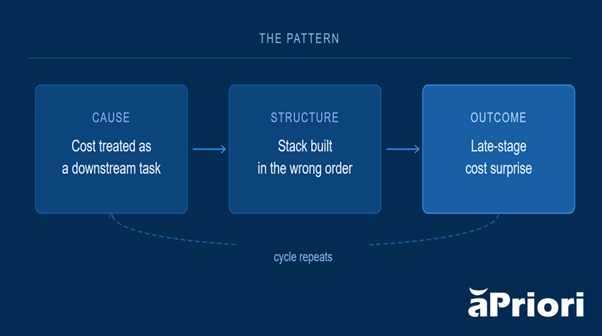
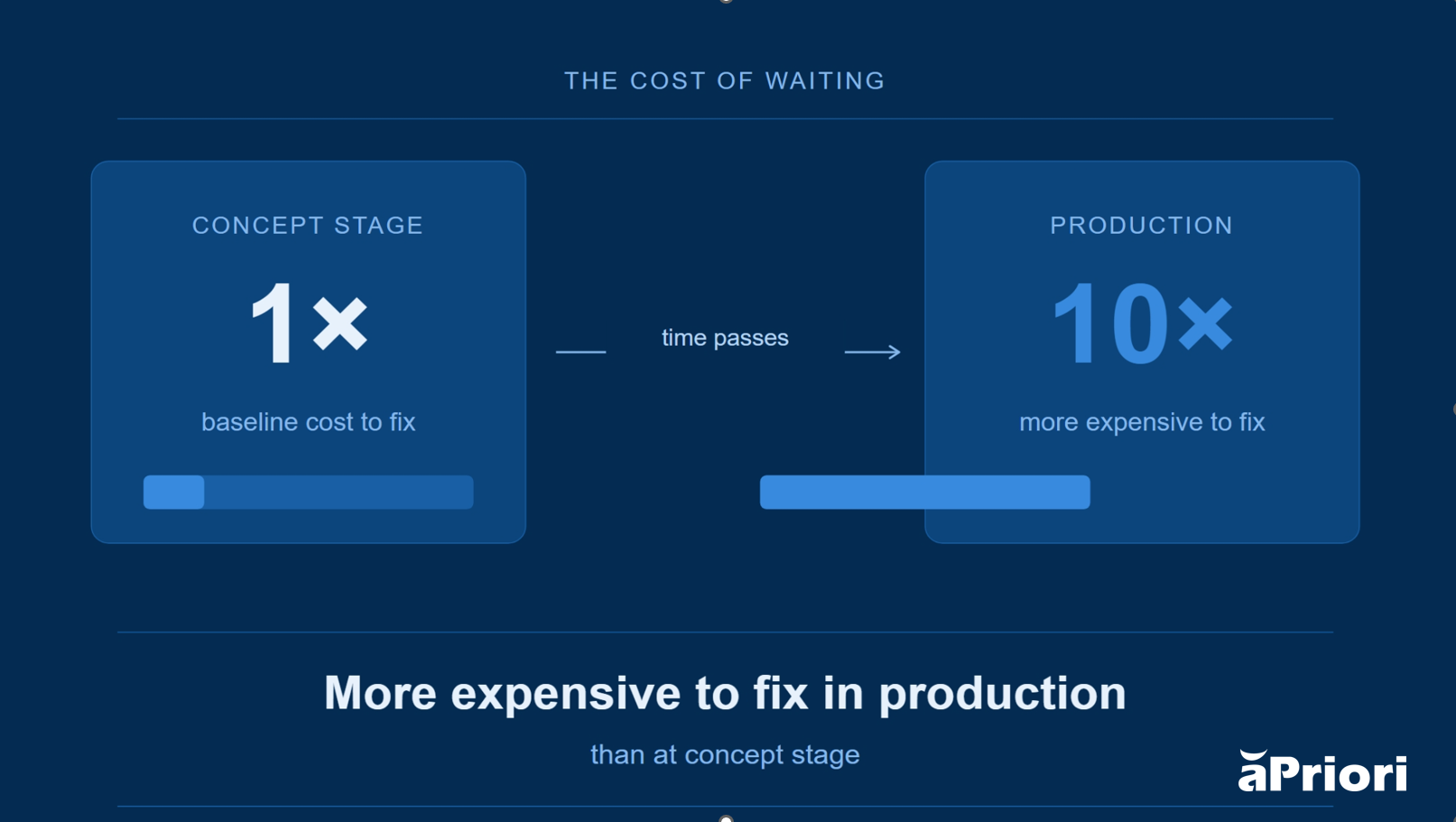
The consequence is predictable. Expensive surprises surface at design review. Tooling, materials, and assembly costs emerge after months of engineering investment. Redesigns that could have been avoided with a different material choice on day three happen on day ninety, incurring significant intangible costs in team morale and momentum.
The stack’s shape became a self-fulfilling prophecy: cost tools were placed late, so cost insights arrived late. As a result, the culture came to expect late cost surprises.
The Rethought Pyramid
Reordering the stack doesn’t mean abandoning CAD or simulation. It means recognizing that cost and DFM are not independent finishing operations. They are design constraints that belong in the geometry conversation from the start.
In a rethought pyramid, cost moves down next to data management. DFM, which is ultimately a measure of how well a design aligns with manufacturing reality, moves with it. Cost becomes a live design key performance indicator (KPI).
And it’s visible in the same environment where engineers are engaged in decision-making, not in a spreadsheet that arrives weeks later. DFM feedback becomes part of the design loop, not a gate at the end.
This isn’t a theoretical aspiration. Modern tooling makes it feasible. Automated cost estimation and financial forecasting can now operate directly on CAD geometry.
Now, cost feedback within the design environment can be received without requiring a dedicated cost engineer in the loop for every iteration. DFM analysis can flag manufacturability issues at the seminal point of design, not after review.
The technology to invert the stack exists. The question is whether organizations choose to use it at the right stage of their development initiatives.
Design Engineering Stack? Tech Stack? Both? It Depends
All humans have basic needs. However, not everyone may need or want each one in Maslow’s hierarchy.
The same is true for manufacturing companies. All need to focus on fit, form, and function (and cost, because no business will thrive without considering them). However, not every manufacturer requires the same needs and wants higher up the hierarchy. Conversely, some companies might require nearly all of them. Let’s consider a few examples:
Design Engineering Stack Only
A custom furniture maker (e.g., a high-end bespoke woodworking studio) needs CAD software, rendering tools, materials libraries, and CNC programming software. However, their “manufacturing” is done in a small workshop staffed by skilled craftspeople. No factory automation, no IoT sensors, no Manufacturing Execution System (MES). The complexity lives entirely in the design phase.
Tech Stack Only
A contract PCB assembler (e.g., a company that stuffs and solders circuit boards to other companies’ specs) receives complete, locked design files from clients and never touches them. Their stack is all operational: ERP, MES, supply chain management software, pick-and-place machine control systems, automated optical inspection (AOI) software, and quality/traceability databases. There is little need for CAD or engineering design tools internally, just the need to read designs from others.
Both
A medical device manufacturer absolutely needs both. On the design side: CAD/CAM for the part and assembly geometry, FEA simulation tools, PLM software for regulatory document control, and Failure Mode and Effects Analysis (FMEA) tooling.
On the manufacturing side: CNC machine control software, cleanroom environmental monitoring systems, MES for lot traceability, ERP for supply chain, and quality management systems (QMS) tied to FDA 21 CFR Part 11 compliance. Neither side can exist without the other because design changes must flow directly into production with full audit trails.
The dividing line is essentially: who owns the design? If you design but outsource production, you need engineering tools. If you produce but outsource design, you need operational tech. If you do both — especially in regulated industries — you need the full picture.
Where aPriori Fits In The Rethought Pyramid
aPriori is built precisely for this inversion. Its platform brings automated, geometry-driven cost and manufacturability analysis directly into the design workflow. It is not a downstream review step either. Instead, it is a live signal available to engineers from the earliest stages of development.
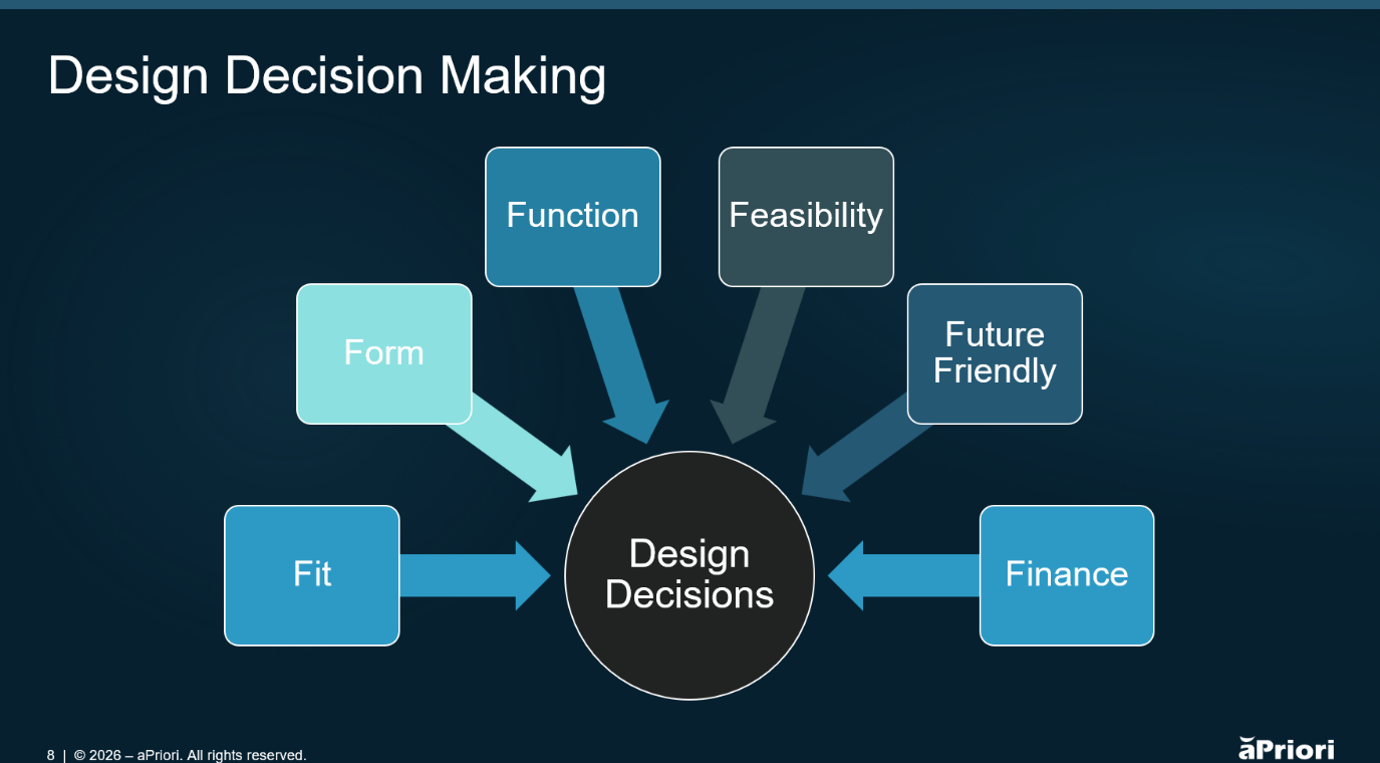
By ingesting CAD geometry and applying digital manufacturing, aPriori generates should-cost models that provide accurate costs that reflect real manufacturing economics: cycle times, tooling requirements, material costs, direct costs, indirect costs, and regional labor rates. Engineers can see, in near real time, how a design decision, such as a wall thickness, tolerance, or material substitution, translates into fixed costs and total costs for production.
DFM feedback surfaces in the same workflow. Issues that would traditionally appear at late-stage manufacturing review, including features that complicate tooling, geometries that drive up machining time, and assemblies that resist automation, are visible when they can still be addressed cheaply.
The result is that cost stops being a number that arrives at the end of a development program and starts being a design parameter that shapes the program throughout. This is what it means to move cost down the pyramid.
The Decision Behind The Diagram
Nobody argues about whether CAD belongs at the base of the stack. The need to design before you can analyze, simulate, or cost is self-evident. The dependency is obvious.
Dependency in the other direction is equally obvious.
Consider this: A product that cannot be made at a competitive price does not reach customers. Market viability is as fundamental a survival condition as having a design in the first place. And cost is how viability is measured.
Therefore, where your cost tools sit in the stack is not a software configuration decision. It is a product strategy decision regarding resource allocation. Treating cost as a top-of-pyramid refinement is a choice. However, it is one with consequences that appear reliably and expensively at late-stage design reviews.
The rethought pyramid isn’t about conducting a cost-benefit analysis (CBA) more often. It is about recognizing that cost has always been foundational. That’s why it’s important to build a stack reflective of it.






Close The Gap Between Design Intent & Production Reality
Real-time cost, CO₂, and manufacturability analysis is changing how engineering teams make decisions — compressing cycles from weeks to hoursSecure Your Spot