Resources Hub


Cost Breakdown Analysis: What Goes Into an aPriori Estimate

April Guenet
— November 10, 2026
Key Takeaways:
- Should cost analysis helps manufacturers understand part costs and make better sourcing decisions
- Material, process, and factory differences explain price gaps
- Cost breakdown analysis reveals hidden costs and savings opportunities
The Full Article:
When a sourcing team first sees a should cost estimate, the first reaction is often a question: Where did this number come from?
The question matters most when the estimate is well below a supplier’s quote. No one wants to defend a number they can’t explain in a negotiation. A cost breakdown analysis shows what’s behind the difference.
Trust in an aPriori estimate starts with seeing what goes into it. This post shows how aPriori builds the estimate from the CAD model, how it calculates material costs, labor costs, and overhead expenses, and how to use that data to read the gap with a supplier’s quote.
What a Should Cost Estimate Is and Isn’t
Should Cost vs. Will Cost
A should cost estimate calculates the expected cost to make a part based on its geometry, material, manufacturing process, and the machines and regional conditions used to make it. It sets a baseline from regional cost data, not a prediction of what a supplier will charge.
Read our guide to should cost analysis and negotiation to learn more about the method.
A quote shows the “will cost”: what a supplier will charge for the part, based on its production costs and market conditions. Some gap between should cost and will cost is normal because few suppliers have optimized their entire cost structure. The size of the gap helps teams benchmark suppliers and make informed sourcing decisions.
aPriori builds each estimate from the bottom up. Physics-based simulation calculates costs from how the part is made, not from past estimates or outdated quotes.
Why Supplier Quotes Can Be Misleading
A supplier quote reflects its manufacturing costs and interest in winning the business. Send the same part to several suppliers, and their quotes can vary by 40% or more.
However, requesting a quote from a supplier unlikely to win the job can strain the relationship and shouldn’t become the go–forward process. A cost breakdown analysis gives teams another way to investigate price differences and market test a quote before asking suppliers for more information.
What Shapes an aPriori Cost Breakdown Analysis
Five factors shape an aPriori estimate and help explain why it may differ from a supplier quote. The cost breakdown structure shows how these factors affect the total cost of making a part.
1. Geometry and Design Intent
Differences in material, stock size, or suggested design changes can explain why a supplier’s quote is higher than the estimate, even when the reason isn’t clear.
Stock size is one example. If a supplier quotes a different material or stock size, its quote may not be comparable with the estimate. That gives you a more useful question than “Can you take 5% off?” Try this instead: “I see you quoted a different stock size. Can we talk about that?”
Design changes are another example. Suppliers may also recommend design adjustments to make a part easier or less expensive to manufacture. Ask about those changes, too. They may explain the price difference.
The estimate starts with the 3D CAD model, which provides the part’s geometry, tolerances, and material selections. aPriori analyzes the part’s features to determine how each production process affects manufacturing costs. Choices that require more material, longer cycle times, or extra production steps can become cost drivers.
2. Process and Routing
Manufacturing Process Models (MPMs) simulate more than 440 production processes to determine which ones a part requires, in what order, and on which machines. The routing can also include secondary operations like heat treatment, plating, and painting.
Learn more about aPriori’s MPMs and the manufacturing process they simulate.
3. Cycle Time, Material Utilization, and Tooling
The simulation calculates each process’s cycle time, how much raw material becomes part of the finished product, and tooling costs. These factors affect direct costs such as material and labor, while overhead contributes to indirect costs. Together, these cost categories form the total estimate.
4. Regional Data and Factory Conditions
aPriori’s Regional Data Libraries (RDLs) provide labor rates, material prices, and overhead data for more than 90 regions, with quarterly updates.
aPriori combines this data with MPMs to create a digital factory, which is a virtual representation of a real manufacturing facility. Teams can use digital factories to compare make-or-buy options and find factories with the capabilities and capacity to make a part at a competitive cost.
5. Overhead and Supplier Margin
aPriori accounts for machine-related expenses, including power, depreciation, maintenance, and facility costs.
Supplier profit is separate from manufacturing cost. aPriori’s RDLs default to 0% profit margin, but teams can set them to reflect assumed or supplier-given rates. The estimate won’t include a supplier’s profit unless users account for it.
Before comparing an estimate with a supplier quote, check that both use the same material, process, region, and machine assumptions.
Using a Cost Breakdown Analysis to Read the Gap
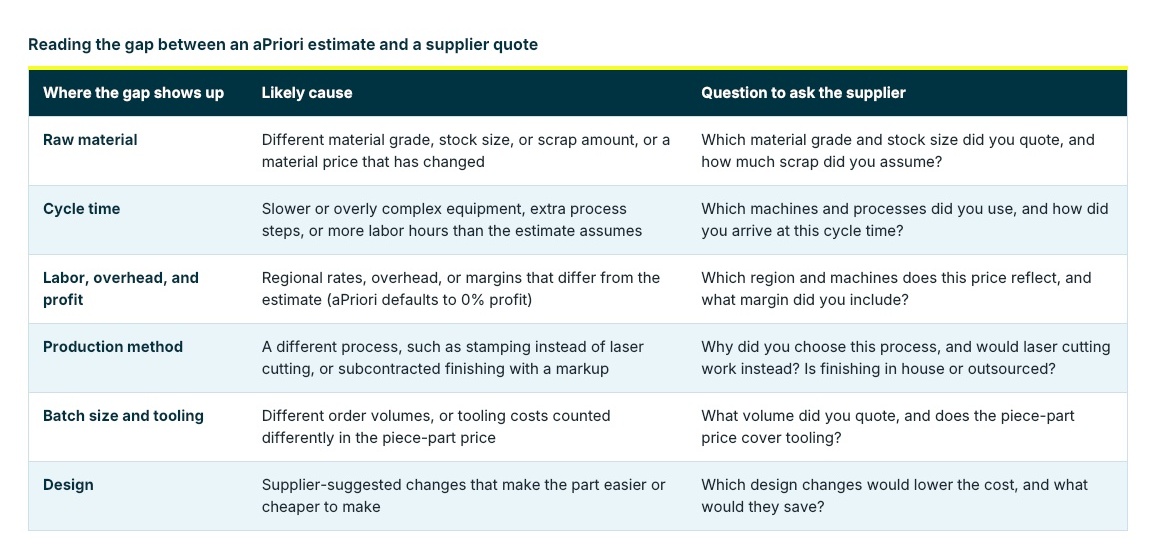
A gap between an estimate and a supplier quote means the two rely on different assumptions, not that either is wrong. A cost breakdown analysis lets you identify that gap line by line. It also gives you leverage for a negotiation that goes beyond asking for a reduction. The table below pairs common gaps with likely causes and questions to ask.
Material and Machining Gaps
Raw material gaps happen when the estimate and quote use different material grades, stock sizes, or scrap amounts. Material prices also change over time, so check which material and prices the estimate uses and how much scrap the supplier expects.
TE Connectivity’s Procurement Cost Analytics teams faced this when a supplier reported a 30% increase in production costs over three years. The team reviewed the product’s costs and found that raw materials, mainly copper, accounted for nearly 65% of the total cost, even though copper prices had dropped by 15% in the market. By negotiating with the supplier, the team reduced raw material costs by 15%, which offset the reported increase. Read the TE Connectivity case study.
Cycle time, or how long a machine takes to make one part, is a major cost driver in machining. A supplier may use slower equipment or an overly complex machine for a simple part, add process steps, or spend more labor hours than the estimate assumes. Ask which machines and processes the estimate used, and how the supplier arrived at its cycle time.
Overhead, Process, and Volume Gaps
Regional labor rates, overhead, and profit margins may differ from the assumptions behind the estimate. Check that the selected region and machines match how the supplier makes the part.
The production method can also affect cost. For example, a supplier might stamp a part that the estimate assumes will be laser-cut. Ask why the supplier chose stamping and whether laser cutting would work instead. Suppliers may also subcontract finishing and add a markup. Check whether the estimate treats that work as in-house or outsourced and compare the added cost.
Batch size and tooling costs also impact the price per part. Compare order volumes and how each figure accounts for tooling, including whether the piece-part price covers it.
When the Supplier is Right
Sometimes the supplier’s quote is accurate. A buyer learns that the supplier uses older equipment and makes fewer parts than the estimate accounts for. The buyer updates the estimate to reflect those details, bringing it closer to the quote. The discussion can then focus on process changes that could lower costs.
Each update makes the estimate more accurate. The more open-book conversations you have with suppliers and update the model to reflect what you agree is fair, the better your estimates become and the easier future supplier negotiations get. Over time, you only need to discuss assumptions that fall outside the norm.
Using the Estimate in Supplier Negotiations
Start with questions, not accusations. Instead of saying, “Your price is too high,” ask, “Can you walk me through this cycle time?” A cost breakdown analysis helps procurement teams show suppliers where the estimate and the quote differ and why. For suppliers with established cost models, teams may not need to request a quote for every part.
Thompson Aero Seating shows how this works. Its sourcing team presented aPriori should cost breakdowns to suppliers to start collaborative negotiations. Within two months of using aPriori, the team saved 40% on its 50 most expensive machined parts. Read the Thompson Aero Seating case study.
Know What’s Behind the Number
A supplier price shows what a vendor will charge. A cost breakdown analysis separates that amount into raw materials, labor, overhead costs, and profit margin. With this detail, procurement teams can compare estimates with quotes, ask what accounts for the gaps, and identify where costs may come down.
When teams see how aPriori builds each number, they can trust the estimate and explain it to suppliers.





From Validating Quotes to Negotiating With aiSource
Most buyers use the supplier quote as their price guide. Is it accurate and fair? aiSource makes every buyer your best negotiator.Discover More