
Resources Hub


The Hidden Cost of DFM Knowledge Gaps: 10 Warning Signs Every VP of Engineering Should Watch

Chris Jeznach
— April 28, 2026
Listen to this Article
1×
00:00
00:00
Key Takeaways
- DFM should be embedded early in the product design process, not treated as a late-stage check
- Without manufacturing visibility early in design, costs can sneak in throughout the product development process, from the design itself through to higher supplier prices
- Early, data-driven DFM enables faster launches, lower costs, and a competitive advantage
The Full Article
DFM Is No Longer Just an Engineering Detail—It’s Foundational To New Product Development Success
As a VP of Engineering, you’re accountable for more than product performance—you own timelines, cost targets, scalability, and ultimately, the success of new product development, design, and launches.
Yet many of the issues that derail programs—missed cost targets, delayed launches, quality issues—don’t originate in production processes. These DFM knowledge gaps begin much earlier, in product design decisions made without full visibility into manufacturing realities. Lack of knowledge or experience in a particular area and design oversights due to time constraints can quietly undermine launch performance, cost targets, and scale readiness before leaders realize it.
Checking a Design for Manufacturability (DFM) is often treated as a downstream check or a manufacturing responsibility. In reality, it is a strategic capability that must be embedded upstream in engineering.
Organizations that operationalize DFM early in the process are better positioned to:
- Hit cost targets more reliably
- Reduce late-stage engineering churn
- Scale production without disruption
- Improve products’ time to market
Those who don’t operationalize DFM early tend to operate in a reactive mode. They end up fixing manufacturability issues after they surface, often requiring a costly redesign, with a cost of change that is exponentially higher.
This is where digital manufacturing platforms like aPriori are changing the equation—giving engineering leaders the ability to embed manufacturing intelligence directly into design workflows, at scale.
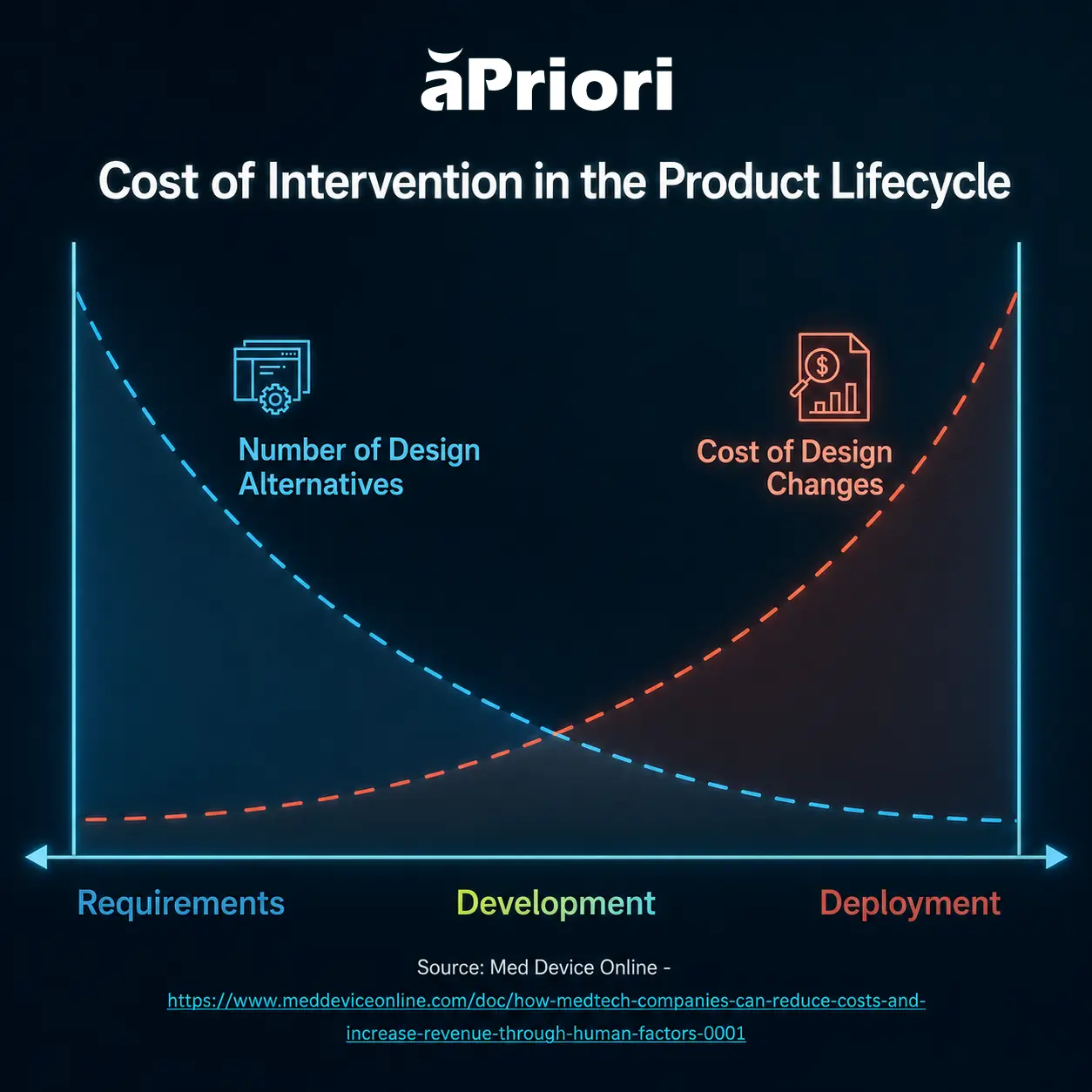
Figure 1: The number of design requirements and changes can increase product costs. Early insight into manufacturability and cost issues reduces the need for expensive ECOs and rework, and accelerates time to market.
Why DFM Gaps Persist, Even in High-Performing Teams
Not all engineering teams have a talent problem. They have a visibility problem.
Engineers make design decisions based on performance requirements, geometry, and experience, but often without real-time insight into process capability, cost drivers, supplier constraints, or location-specific manufacturing tradeoffs.
The result is predictable: engineering optimizes for function, manufacturing reacts to feasibility issues, and sourcing inherits commercial risk later than it should. The problem is not simply a lack of DFM awareness. It is the absence of a scalable way to embed manufacturing knowledge into design decisions early enough to change outcomes.
10 Indicators Your Organization Has a DFM Gap
These indicators are not isolated engineering issues—they are systemic signals that design decisions are being made without sufficient manufacturing insight or intelligence.
-
Late-Stage Design Changes Are the Norm
If significant changes happen after prototyping or pilot builds, DFM is happening too late.
Impact:
- Extended development cycles
- Increased engineering costs
- Delayed revenue realization
What’s missing: Early manufacturability validation
aPriori’s Capability: Engineers can evaluate manufacturability and cost in real time during design, preventing downstream churn.
-
Production Costs Consistently Miss Targets
When actual manufacturing costs exceed estimates, it’s rarely a procurement issue—it’s a design visibility issue originating in the design phase.
Impact:
- Margin compression
- Pricing pressure
- Reduced competitiveness
What’s missing: Precise, design-stage cost modeling
aPriori’s Capability: Enables granular, process-based cost insights tied directly to design decisions.
-
Scrap and Rework Are Structurally High
Persistent scrap rates point to designs that exceed process capabilities.
Impact:
- Hidden cost leakage
- Lower throughput
- Operational inefficiency
What’s missing: Understanding of process limits during design
aPriori’s Capability: Simulates the entire production process, including processes like injection molding and CNC machining, to flag risks before production.
-
Lead Times Are Longer Than Planned
Manufacturing complexity introduced at the design stage often shows up as delays later.
Impact:
- Missed launch windows
- Inventory and planning challenges
What’s missing: Visibility into cycle times and production constraints
aPriori’s Capability: Identifies complexity drivers early, enabling simplification.
-
Quality Issues Trace Back to Design
If recurring defects are tied to design—not execution—DFM is insufficient.
Impact:
- Warranty costs
- Brand risk
- Customer dissatisfaction
What’s missing: Designing within process capability windows
aPriori’s Capability: Helps ensure designs, including the selection and placement of fasteners, are robust against real-world variation and within specified tolerances.
-
Suppliers Push Back—or Pad Quotes
When suppliers frequently challenge designs or inflate pricing, they are compensating for risk.
Impact:
- Higher cost of goods
- Slower sourcing cycles
- Strained supplier relationships
What’s missing: Alignment between design intent and supplier capability
aPriori’s Capability: Aligns design decisions with real manufacturing conditions globally.
-
Scaling Production Creates New Problems
Products that work at low volume but fail at scale indicate fragile manufacturability.
Impact:
- Bottlenecks during ramp
- Cost spikes
- Quality control instability
What’s missing: Design for scalability, not just feasibility
aPriori’s Capability: Through advanced simulation, it evaluates production scenarios and scaling constraints earlier.
-
Engineering Avoids New Manufacturing Technologies
Limited adoption of automation or advanced processes often signals a DFM knowledge gap.
Impact:
- Missed cost savings
- Slower innovation cycles
What’s missing: Insight into tradeoffs between manufacturing methods
aPriori’s Capability: Enables comparison of alternative manufacturing processes and material selection.
-
Cross-Functional Misalignment Is Common
If sourcing or manufacturing teams are “surprised” by designs, DFM is not integrated.
Impact:
- Rework loops
- Organizational friction
- Slower decision-making
What’s missing: Shared data and early collaboration
aPriori’s Capability: Creates a common data foundation across engineering, manufacturing, and sourcing.
-
Field Failures Reveal Design Weaknesses
The most serious signal: issues that escape into the field due to manufacturability.
Impact:
- Customer impact
- Safety risk
- Long-term brand damage
What’s missing: Robust validation of design under manufacturing variation
aPriori’s Capability: Ensures designs are production-ready—not just theoretically sound.
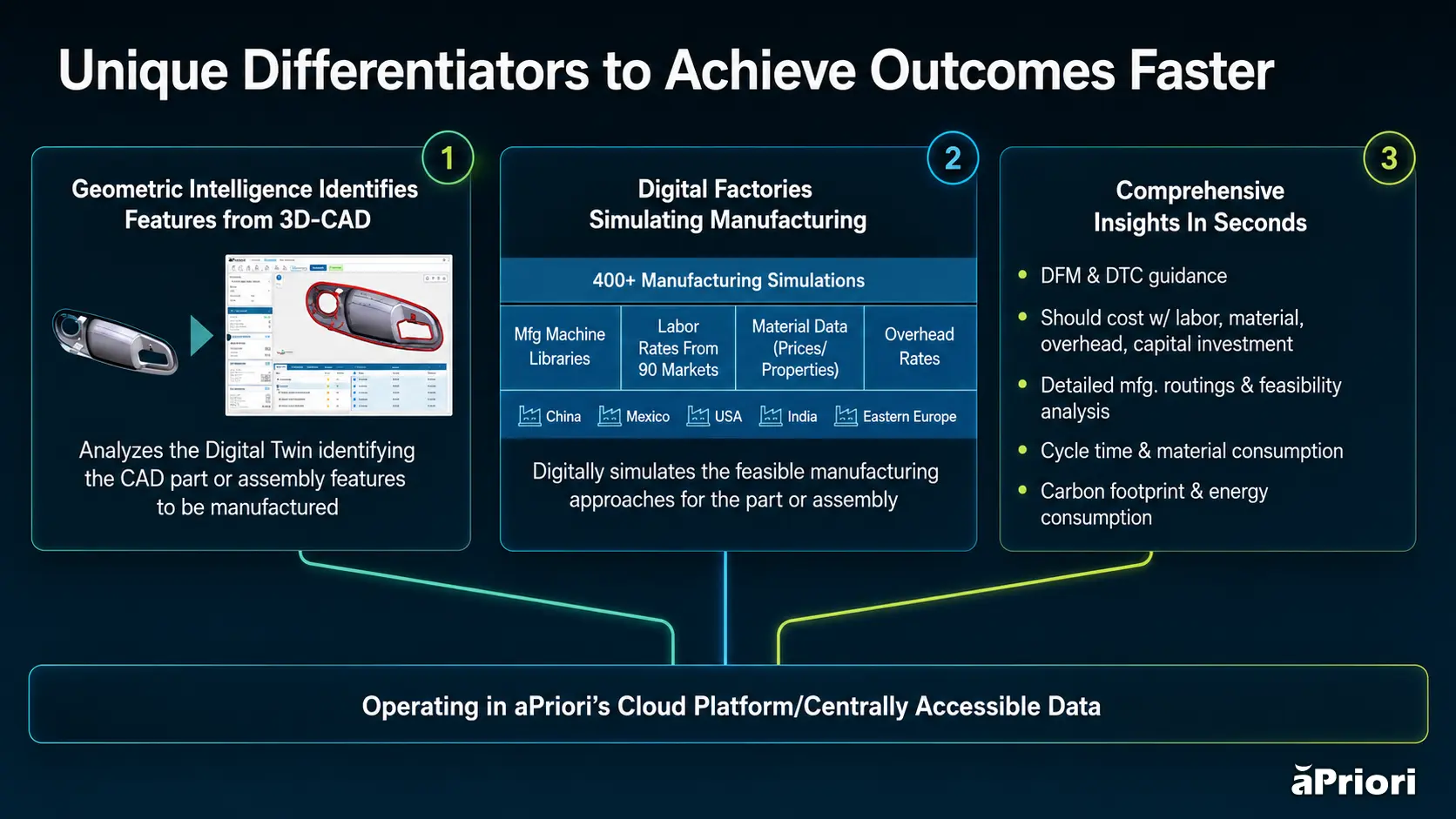
Figure 2: Outcomes can be achieved faster by using aPriori’s Cloud Platform/Centrally Accessible Data (geometric intelligence identifies features from 3D CAD, digital factories simulate manufacturing, and comprehensive insights in seconds)
Closing the Gap: What Leading Engineering Organizations Do Differently
Closing DFM and DFA gaps does not require more reviews. It requires changing how design decisions get made. Leading organizations do five things consistently:
Shift DFM left.
Evaluate manufacturability and cost from the earliest design stages, not after design is complete. Use real-time feedback inside the CAD workflow to guide decisions as they happen.
Standardize decision-making.
Do not depend on individual judgment alone. Establish common cost models and repeatable DFM methods, so teams make decisions consistently at scale.
Replace estimates with data.
Move away from manual, variable cost estimates. Use process-based costing and scenario analysis grounded in real manufacturing conditions.
Align engineering, manufacturing, and sourcing.
Make DFM a shared responsibility. Give cross-functional teams a common set of cost and manufacturability data so they can act faster and with less friction.
Digitize manufacturing knowledge.
Capture and embed manufacturing expertise in the design process. Reduce reliance on tribal knowledge and make guidance accessible to every engineer.
The Strategic Payoff
When organizations operationalize DFM at the engineering level, they improve cost predictability, reduce iterations, accelerate launches, strengthen supplier alignment, and improve product quality.
From Engineering Discipline to Competitive Advantage
DFM is no longer merely a best practice. It requires adhering to DFM principles is a competitive differentiator. Those who operationalize manufacturability insights early reduce avoidable churn and make scaling up more predictable.
The organizations pulling ahead are not simply better at manufacturing—as evidenced by numerous case studies—they are better at designing for manufacturing from the start.
They equip their design engineers with real-time insight into cost and feasibility, eliminate guesswork, and align teams around shared data. Additionally, they make better decisions earlier.
aPriori enables this shift by bringing manufacturing intelligence directly into the design process, allowing engineering leaders to move from reactive problem-solving to proactive optimization.
The opportunity is clear: Turn DFM from a late-stage checkpoint into an embedded capability and transform engineering from a cost center into a driver of margin, speed, and cost-effective competitive advantage.





Is Your Product Development Process Reactive?
If so, this webinar is for you. See how automated analysis transforms product development from reactive handoffs into a proactive, collaborative, & streamlined process that boosts profits.Watch The Webinar

More Resources:
- Blog: Close The Design Engineer Skills Gap with Manufacturing Insights
- Video: How Tolerances Shape Cost and Manufacturability
- Case Study Podcast: How Design for Manufacturing Saves $Millions
- Podcast: Shift Left with AI

