
Resources Hub


How Design-To-Source Intelligence Turns Quoteless Sourcing Into An Engineering Discipline

April Guenet
— August 6, 2026
Listen to this Article
1×
00:00
00:00
Key Takeaways:
- Design-to-source intelligence is the missing link in new product development (NPD). Most NPD processes treat sourcing as a downstream handoff
- Embedding cost and manufacturability intelligence at the design stage closes that gap, compressing time-to-market and reducing the rework cycles that quietly erode product margins before launch
- Direct procurement gains negotiating power, since buyers have physics-based should cost data tied to specific supplier capabilities and regional cost structures. The dynamic shifts from price-taking to price-knowing and a structural advantage
- Supplier optionality built into design is the foundation of supply resilience. Designs built to be producible across multiple suppliers and geographies from the start ensure resilience becomes a deliberate output of the engineering process
The Full Article
Procurement is cleaning up an engineering quagmire that it was never intended to prevent.
Engineering finishes a design. Procurement receives it. Sourcing sends it to five suppliers. Quotes come back. Someone picks the lowest bid. A purchase order goes out. Six to ten weeks have passed, which most accept as the norm.
It shouldn’t be the norm. It’s just a workaround that became a workflow.
Uncertainty Shouldn’t Be The Name of The Procurement Game
The RFQ process exists for a specific reason: uncertainty.
Uncertainty about…
- what something costs to make
- whether it can even be made by the suppliers you’d want to use
- whether the design is optimized for the region where you need it built or the manufacturing process required to produce it
- which processes are most efficient at each supplier
- whether your supplier actually owns the necessary machines or has to subcontract them from other suppliers
If you had that information before the design was released, you wouldn’t need the RFQ. At a minimum, you wouldn’t need it the way you use it today: as a discovery mechanism rather than a confirmation mechanism.
This is the uncomfortable dilemma that procurement does not vocalize: sourcing speed is an engineering problem masquerading as a procurement problem.
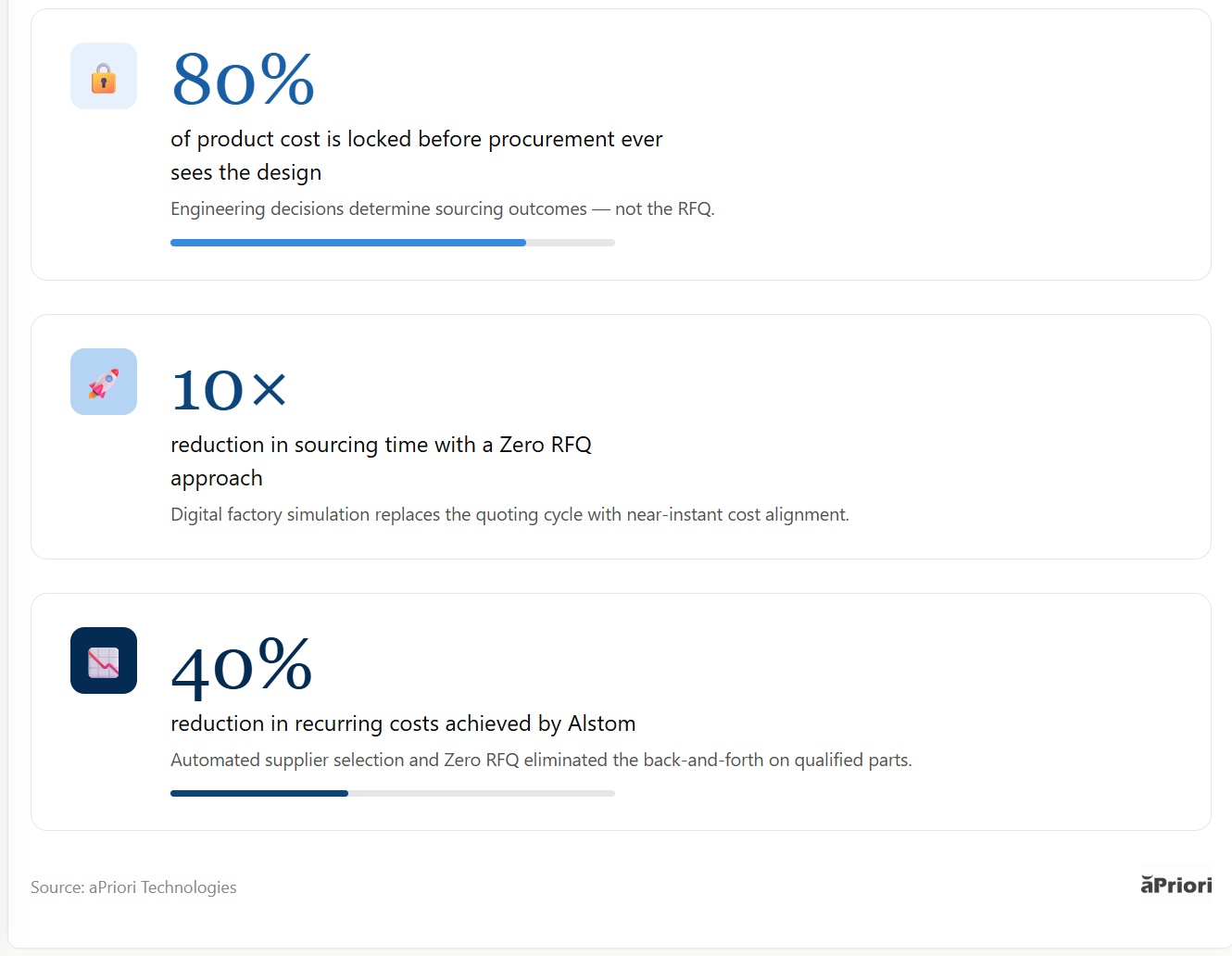
How Engineering Decisions Determine Supplier Optionality Unwittingly
Walk through any RFQ process, tracing its questions backward. You will likely encounter several scenarios.
Scenario One: A supplier asks for clarification on a tight tolerance. That tolerance was set by an engineer who defaulted to it. Not because the function required it, but because it’s what they always use. The tolerance eliminates two potential suppliers before the bid even opens.
Scenario Two: A buyer gets quotes back with a spread three times the average. The cheapest quote assumes a machining process that the design can’t fully support. The second assumes a supplier in Germany with labor rates three times higher than in Malaysia. The quote closest to the target cost set comes from a supplier in Mexico. However, the buyer doesn’t have visibility into why it’s accurate, so they don’t trust it.
Neither of these scenarios is the fault of procurement. Procurement is working with what engineering gave them. But procurement is the one absorbing the timeline, cost, and organizational friction of resolving it.
Engineering Speaks Geometry & Procurement Articulates Cost & aPriori Translates Both
The encoded design addresses every question the RFQ seeks to answer. It just didn’t produce legible answers until manufacturing simulation and should-cost analysis translated the geometry into cost language. Having the manufacturing intelligence, layered throughout from design to source, would have garnered more beneficial feedback, such as this:
A rounded corner instead of a sharp edge could save your company thousands. But a keen understanding of manufacturing feasibility, global sourcing options, material selection, and machine capabilities is critical.
Historically, engineers haven’t had that feedback until it was too late. That’s the gap aPriori was built to close.
When you simulate a design against a real digital factory, complete with machine rates, cycle times, labor costs for a specific region, and tooling constraints, you’re translating engineering intent into sourcing intelligence in seconds.
The design isn’t just a drawing anymore. It’s a cost model. A manufacturability signal. And a regional sourcing recommendation.
The Ownership Shift
This isn’t a technology argument. It’s an organizational one.
The most challenging part of the quoteless-ready design concept isn’t technical. aPriori has been building digital factories, accumulating regional cost data, and developing simulation models that translate CAD geometry into manufacturing intelligence for two decades.
The challenging part is organizational: who owns sourcing speed?
If it’s procurement, and typically by default they do, then the lever is faster RFQs, better supplier performance and relationships, and more aggressive timelines. All are valuable but inherently limited by the design quality they receive.
If engineering owns it, then the lever is the design. Tolerances, material choices, and process assumptions are baked into geometry. Supplier optionality is engineered in from the start. These decisions compound.
A design team that consistently ships quoteless-ready designs doesn’t just speed up sourcing on individual parts. It structurally reduces the RFQ burden across the entire portfolio.
This is a mindset shift that will be met with resistance. Engineers will say this isn’t their job. Procurement will worry about losing control of the sourcing process. Leadership will ask how to measure it. The answer to all three: the data is already there.
When aPriori is deployed in engineering, integrated with PLM, running DFM and cost analysis automatically at 100% BOM coverage, every design decision generates sourcing intelligence as a byproduct. The engineer doesn’t need to become a cost engineer. The cost intelligence comes to them. Real-time intelligence now reaches sourcing in time to eliminate the uncertainty that the RFQ was traditionally created to resolve.
“Allowing cost to be a design variable benefits the entire organization.”
— aPriori customer, G2 review
aPriori: Your Design To Source Intelligence Partner
aPriori’s design to source intelligence models real world production environments, including machining, molding, casting, additive manufacturing, and assembly. It then returns design for manufacturability (DFM) feedback, cycle time estimates, detailed cost breakdowns (labor, material, machine, tooling), and carbon footprint analysis simultaneously. It runs automatically, at 100% bill of materials (BOM) coverage, integrated directly with PLM systems like PTC Windchill.
The Result: By the time a design reaches sourcing, it already carries a should-cost model, a regional fit recommendation, and a supplier-alignment profile. The RFQ stops being a discovery tool and becomes a confirmation step.
The RFQ Doesn’t Create Restraints: It Inherits Them
Every week, a sourcing cycle burn is traced back to an engineering decision made weeks or months earlier. Perhaps a tolerance defaulted to a material specified without a regional context, a process assumption nobody questioned.
The RFQ didn’t create those constraints. It inherited them. Closing that gap doesn’t mean speeding up procurement. It means making engineering cost-aware from the start, so that by the time a design reaches sourcing, most of the hard questions already have answers.
What “Quoteless-Ready Design” Actually Means
Quoteless-ready is not a utopian state where RFQs disappear entirely. It’s a set of engineering decisions made with manufacturing and sourcing intelligence embedded in the process. When a part goes to a supplier, it does so with confidence rather than questions.
A quoteless-ready design has four properties:
- Knows the costs before anyone asks: There is no cost engineer spreadsheet or three-bid supplier quotes based on different process assumptions. Instead, it’s a physics-based, deterministic should-cost model derived from the part’s design method, required materials, and processes cost relevant to the manufacturing region. aPriori automatically provides all these factors, using the same reference points suppliers use when building their quotes.
- Identifies where the part/product can be built: aPriori’s regional data library, updated quarterly, provides labor rates, machine costs, and overhead structures across global markets. A quoteless-ready design has already been evaluated across multiple sourcing geographies. The engineer or sourcing team already knows whether Mexico, Germany, or Malaysia is the optimal production region for this part at this volume, before the RFQ is written.
- Can determine whether it can be built: DFM issues that surface at release are more costly to resolve than those that appear in the design stage. A quoteless-ready design has already passed manufacturability analysis for the processes available at likely suppliers. Radii are correct. Wall thicknesses are validated. Tolerances are set to what the function actually requires, not the engineer’s default.
- Maximizes supplier optionality
Supplier optionality is likely the most strategically valuable property of all. A design that can be produced by multiple suppliers, across multiple regions, gives procurement real leverage. It converts a single-source dependency into a competitive negotiation.
aPriori Capability — Zero RFQ & aiSource
aPriori’s Zero RFQ approach creates digital versions of your strategic suppliers’ factories. They are calibrated to their actual machine rates, margins, and process assumptions. When a new part arrives, the system runs the simulation against those digital factories and returns a supplier-aligned cost instantly. The buyer can send a purchase order to the best-fit supplier without a quoting cycle.
aPriori’s aiSource takes this further: it makes that physics-based intelligence conversational, putting should-cost breakdowns and negotiation guidance in front of every buyer on the team. The conversation with suppliers shifts from “Your price is too high. Can you do better?” to “Here’s why it should cost less.”
The Evidence
Engineering decisions that drive supplier optionality aren’t just a nice-to-have; they’re a reality for aPriori customers. Here’s what it looks like in practice:
The Zero RFQ Approach
Alstom, a rail and transit manufacturer, used aPriori’s automated supplier selection and Zero RFQ approach to reduce recurring costs by 40%. Rather than just accelerating quoting, Alstom wanted to eliminate quoting iterations on qualified parts. As a direct result of having should-cost models calibrated to specific supplier capabilities before the part ever went to bid, it was achieved.
The manufacturers who achieve the largest sourcing improvements aren’t the ones who optimized the RFQ process. They’re the ones who moved the cost and manufacturability conversation into engineering—earlier, with better data, before the decisions that drive sourcing complexity were already made.
aPriori: Automated, Actionable Insights at Scale
aPriori reviews 100% of product designs automatically, not just a sample or periodic audit. Integrated with PLM systems such as Windchill, it continuously monitors designs, runs manufacturability and cost analyses, and alerts engineers to exceptions.
The result: Every engineer on the team has access to the same quality of sourcing intelligence that previously required a cost engineering specialist. Sourcing teams receive designs that have already been analyzed. Best of all, they’re confirming decisions, not discovering problems.
Tip:
Next time your team is running behind in a sourcing cycle, take one step before adjusting the timeline or escalating to suppliers:
- Pull the design. Look at the tolerances, material specifications, and process assumptions encoded in the geometry.
- Ask whether any of those decisions constrained your supplier options before the RFQ was ever written.
If the answer is yes, and it usually is, the next question isn’t “how do we speed up sourcing?” It’s “how do we get sourcing intelligence into engineering before the design is locked?”
That’s the conversation aPriori enables. Not by automating the RFQ. By eliminating the conditions that make the RFQ necessary.





Empower Your Engineering and Procurement Teams To Launch Faster & More Profitably
See how automated analysis transforms product development from reactive handoffs into a proactive, collaborative, and streamlined process, driving bottom-line resultsAccess The Webinar

