
Resources Hub


Delivering on Margin Expansion Promises in Volatile Markets: A CFO Playbook for Investor Confidence

Chris Jeznach
— May 19, 2026
Listen to this Article
1×
00:00
00:00
Key Takeaways:
- Margin volatility is an upstream problem. Up to 70–80% of product cost is determined during design, long before finance is involved, making reactive cost management structurally too late
- Investors want proof that margin improvement is repeatable. Analysts are scrutinizing whether gains are structural or transient, demanding more than headline numbers and generic explanations
- Shared cost intelligence across functions is the real differentiator. When engineering, procurement, and finance work from a unified cost framework, manufacturers can proactively manage margin risk instead of explaining variances after the fact
- aPriori is a win for every team. When Finance champions its adoption, Engineering gains the tools to design smarter and faster. Procurement walks into supplier negotiations armed with hard data. Then, Finance can confidently back earnings reports with real cost evidence
The Full Article
Public manufacturing companies are under unprecedented pressure to prove that margin expansion is not just possible, but sustainable.
Every earnings call and investor presentation now carries heightened scrutiny around profitability. Analysts want to understand whether margin gains are operationally durable or simply the result of temporary pricing strategies or actions. Investors are asking whether manufacturers can continue improving Earnings Before Interest, Taxes, Depreciation, and Amortization (EBITDA) and free cash flow while navigating inflation, supply chain instability, tariffs, labor shortages, and slowing demand.
For CFOs, this creates a difficult balancing act. They must communicate confidence externally while managing volatility internally. This entails guiding investors toward long-term profit margin targets while recognizing that many factors affecting product cost are moving faster than traditional financial planning and metrics can accommodate.
And increasingly, the biggest challenge is not what happens in finance. It is what happens before finance ever sees the numbers.
Earnings Calls Under a Microscope
Investors and analysts are no longer satisfied with headline-making gross margin figures. They are dissecting underlying drivers, such as asking whether improvements are structural or transient, and whether management has sufficient visibility into forward cost exposure.
When an analyst asks about gross margin guidance, they are often really asking: Are reported cost savings repeatable, or did they result from one-time supplier concessions? If input costs rise next quarter, does management have enough flexibility to protect margins? Are there design or sourcing commitments already made for upcoming launches that could constrain future performance? And is the management team proactively controlling cost risk, or typically reacting to variances after they appear in the numbers?
These questions are more difficult to answer convincingly when cost data lives in disparate systems and engineering workflows and decisions are disconnected from financial modeling.
Most CFOs are preparing earnings commentary using financial data that lags operations by weeks. Cost variances surface in the general ledger long after the design, sourcing, or production line decisions that caused them. CFOs are being asked to provide forward-looking margin guidance based on a model that is structurally backward-looking.
Manufacturers that consistently deliver on margin commitments and can articulate clear, process-based reasons for their confidence earn lower cost of capital, stronger analyst relationships, and greater resilience during market sell-offs. Closing that credibility gap requires earlier, more systematic visibility into the decisions that determine product cost before those costs are locked in.
Why Margin Volatility Starts Earlier Than Most Financial Models Capture
One of the largest disconnects in manufacturing finance is the assumption that product cost becomes controllable once sourcing and production begin.
In reality, material selection, geometry, tolerances, manufacturing methods, and supplier strategies can all influence product cost long before procurement receives a quote or finance sees a forecast. Financial commitments are made to the market based on expected margin performance, yet many cost-driving decisions are occurring upstream in engineering with limited real-time financial insight.
A small design decision can create significant downstream impact when scaled across production volumes. Manufacturing complexity that goes unnoticed during development can surface later as scrap, rework, throughput constraints, or warranty exposure. By the time those issues appear in quarterly reporting, operations management teams are forced into reactive explanations.
Investors increasingly recognize this pattern and want evidence that manufacturers have stronger systems in place to optimize savings and manage cost risk before it becomes financial risk.
The Shift From Cost Reduction to Margin Governance
Leading manufacturers are taking a different approach to margin expansion. Instead of treating profitability improvement as a downstream recovery exercise, they are building cost intelligence into the earliest stages of product development.
This shift creates several competitive advantages for CFOs. When product teams can evaluate cost implications during design and sourcing decisions, finance gains earlier insight into whether products are tracking toward target margins, identifying risks while corrective action is still relatively inexpensive. Organizations with stronger design-stage cost visibility can also communicate margin outlooks with greater confidence, reducing uncertainty around gross margin forecasts, launch profitability, regional sourcing exposure, and tariff sensitivity.
Perhaps most importantly, it enables cross-functional accountability. Engineering, procurement, manufacturing, and finance often operate from different assumptions. Without a shared cost framework, these functions can unintentionally work against each other, creating margin leakage that is difficult to trace and even harder to explain on an earnings call.
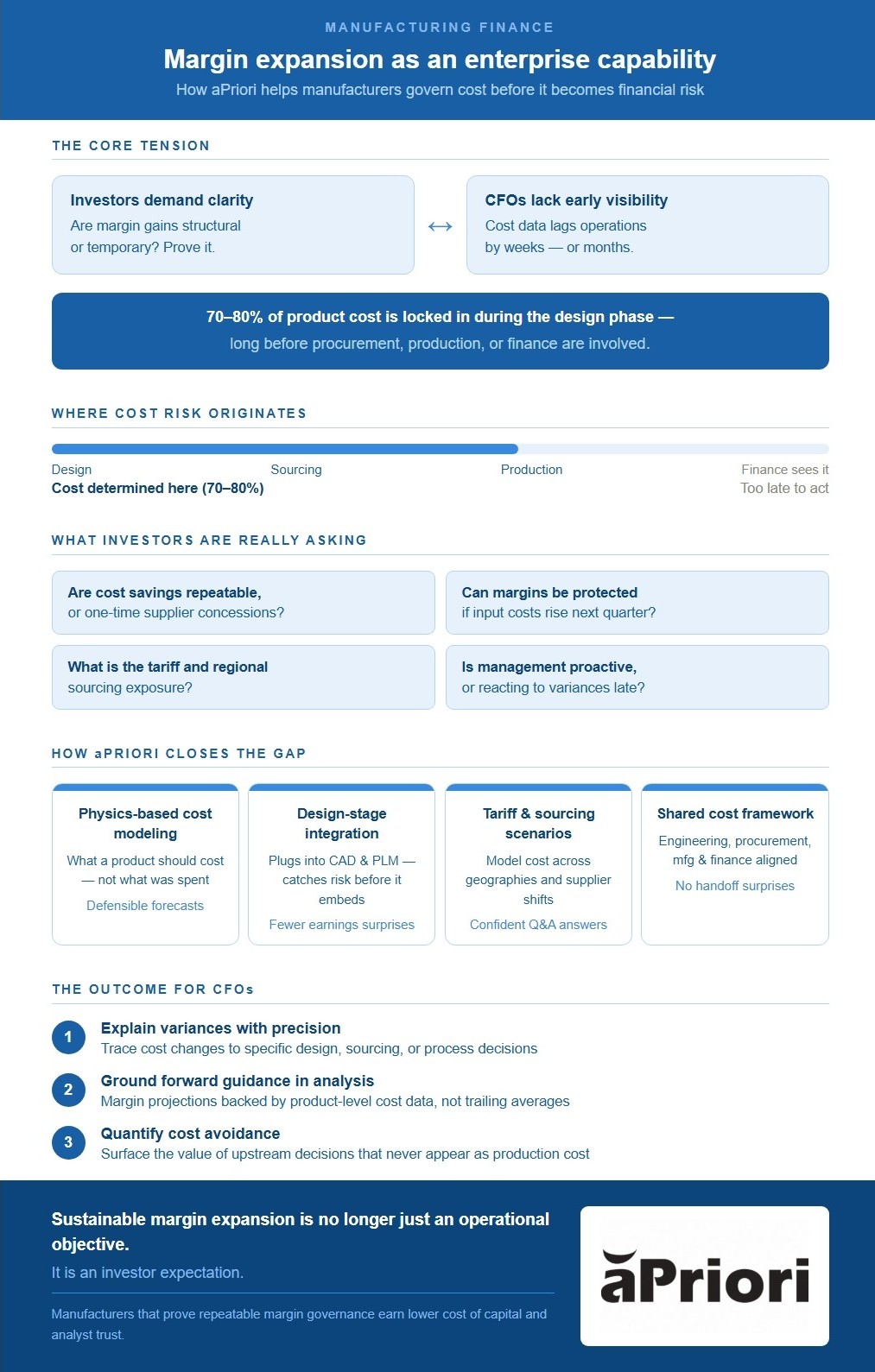
With aPriori, manufacturers can govern cost before it becomes a financial risk as shown in this infographic.
How aPriori Supports Margin Predictability and Investor Confidence
aPriori helps manufacturers move from reactive cost management to proactive margin governance by bringing product cost visibility into the product lifecycle earlier. Using digital manufacturing simulation and physics-based cost modeling, aPriori enables manufacturers to evaluate the financial impact of design, sourcing, and manufacturing decisions before products reach production.
Physics-Based Cost Intelligence, Not Just Spend Analytics
Most cost management tools analyze what has already been spent. aPriori models what a product should cost based on its geometry, raw materials, tolerances, and manufacturing process — independent of supplier quotes. When finance leaders can ground margin projections in physics-based manufacturing reality rather than historical spend averages, cost assumptions become significantly more defensible. Analysts challenging gross margin guidance get a clearer, more rigorous answer than “Our procurement team negotiated well last quarter.”
Earlier Intervention in the Cost Curve
Manufacturing industry research shows that 70 to 80 percent of a product’s cost is determined during the design phase — long before procurement, production, or finance are meaningfully involved.
Most cost management tools operate after that window has closed. aPriori integrates directly with CAD and PLM environments, enabling cost evaluation during the design process itself. For CFOs, this means cost risk is identified and addressed before it becomes embedded in the product, reducing the likelihood of earnings-cycle surprises driven by decisions made months or years earlier.
A Shared Cost Language Across Functions
aPriori creates a unified cost framework that engineering, procurement, manufacturing, and finance can work simultaneously and in partnership. When a design engineer evaluates a geometry change, they see the same cost implications as a procurement lead or a financial analyst would. That shared visibility eliminates the handoff friction that typically turns design-stage decisions into finance-stage surprises and gives CFOs a defensible, cross-functional basis for the margin story they tell investors.
Trade policy volatility has made sourcing exposure a first-order concern for investors. CFOs are now regularly asked on earnings calls to quantify tariff exposure, describe sourcing flexibility, and explain contingency plans if geopolitical conditions force supply chain restructuring. aPriori enables manufacturers to model cost impact across multiple sourcing geographies and supplier profiles simultaneously. A CFO can walk into an earnings call knowing not just what products currently cost, but also what they would cost if production shifted regions, if specific tariffs were to escalate, or if a key supplier became unavailable. That analytical depth transforms reactive investor Q&A into a confident demonstration of operational foresight. One of the most underreported drivers of margin improvement is cost avoidance — the savings that never appear in the production process because decisions were made correctly upstream, such as: These actions create measurable enterprise value, but organizations often struggle to quantify and consistently communicate them. aPriori tracks cost changes across design iterations and operational scenarios, giving executives visibility into how engineering and sourcing decisions contribute to margin expansion, and creating a more complete story for boards, investors, and analysts. The operational capabilities aPriori provides are only as valuable as the financial story they enable leadership teams to tell. When reporting gross margin performance, finance leaders can explain cost variances with greater specificity, tracing them to identifiable design, sourcing, or process decisions rather than citing generic market conditions. By providing forward guidance, margin projections can be grounded in product-level cost analysis rather than extrapolation from trailing averages. In answering analyst questions about tariff exposure, management can offer scenario-based responses backed by quantitative analysis. That combination of specific historical explanation, analytically-grounded forward guidance, and scenario-ready risk communication is exactly what institutional investors are looking for from manufacturing business management teams today. It also reduces the burden of earnings preparation. Teams no longer have to scramble to reconcile cost variances in the weeks leading up to a quarter close. Organizations using aPriori have ongoing visibility into cost performance at the product and portfolio level. They also have a better understanding of where the bottom line will be. For CFOs, this creates an opportunity to reposition margin expansion as a structural capability rather than a temporary initiative. Margin improvement justification shouldn’t be a reactive response to market conditions. Leadership teams can demonstrate that the organization has built systems to proactively manage the cost of goods sold (COGS) across the entire product lifecycle. That distinction signals operational efficiency and maturity, improving credibility. It also gives investors greater confidence that profitability improvements can continue even in uncertain environments. Margin expansion promises are easy to make when markets are stable. They become significantly harder when inflation persists, supply chains shift, and tariffs evolve. Finance teams can work more closely in influencing engineering and procurement teams to adopt aPriori. Engineering can design better, faster, and more cost-effectively the first time. Procurement will have accurate pricing going into negotiations with suppliers to keep costs down. Finance will have data-based evidence to stand by their earnings reports and margin success. Manufacturers can improve margin predictability, strengthen investor confidence, and deliver on profitability commitments with greater consistency. aPriori unifies design, manufacturing, sourcing, and finance into a single shared cost framework for end-to-end visibility. Because in today’s market, sustainable margin expansion is not just an operational objective. It is an investor expectation.Tariff and Regional Sourcing Sensitivity Analysis
Quantifying Cost Avoidance
Connecting aPriori Insights To The Earnings Narrative
The New Investor Narrative: Margin Expansion As An Enterprise Capability
In today’s market, the most compelling manufacturing stories are no longer centered on pricing power or isolated cost-cutting. Investors increasingly favor companies that demonstrate repeatable operational systems for protecting and expanding margins, with earlier visibility into cost risk, stronger cross-functional alignment, faster decision-making, and greater predictability across product launches.
Delivering On The Promise
The manufacturers that will outperform are not simply the ones cutting costs fastest. They are the ones building earlier visibility into decisions that shape product profitability, aligning engineering, sourcing, manufacturing, and finance around shared cost intelligence, and creating systems that identify margin risk before it reaches the earnings report.






Reduced Costs + Compressed Timelines + Secured Measurable Savings=A Unicorn?
All three are attainable. Discover how Signify reshaped how its procurement team partners with suppliers, delivering more value to the business, using aPriori’s cost intelligence analysis.Watch The Webinar

More Resources:
- Blog: Identify Product Cost Creep and Improve Margin Targets
- Video: Driving Profitability with Insights from Industry Leaders
- Case Study: Learn How Dana Saved Millions in Their First Year Using aPriori Across Their Product Development Lifecycle
- Podcast: CEO Podcast: 2 Biggest Challenges Facing Manufacturing

