Resources Hub


3D CAD Alone Isn’t Enough: How aPriori’s New “DFM Severity Classification” Method Transforms DFM Analysis

Mark Rushton
— March 31, 2026
Listen to this Article
1×
00:00
00:00
Key Takeaways:
- CAD tools enable product design but lack the intelligence to assess real-world manufacturability, cost, and risk
- The old DFM percentage model measured the number of issues, often hiding critical product development problems instead of highlighting their impact in design review
- aPriori’s DFM Issue Severity assessment prioritizes issues by importance, helping engineers focus on what matters most and make faster, more informed decisions in real time
The Full Article
Most engineers assume their 3D CAD system is the center of their design-for-manufacturability (DFM) workflow—and in many ways, it is. Modern CAD platforms are exceptional at enabling fast modeling, parametric control, and visualization. But even the most advanced CAD tools fall short in one crucial area: They lack true, automated DFM intelligence.
CAD can show you geometry. It can constrain features. It can help you visualize assemblies.
But it cannot tell you whether a part can be manufactured efficiently, what operations it requires, or how high-risk certain design phase decisions might be.
aPriori Provides True Manufacturing Intelligence
The gap between traditional CAD systems and advanced manufacturing intelligence is exactly what aPriori has spent years solving—and the upcoming release introduces one of the most meaningful improvements yet: a shift from a percentage-based DFM risk metric to a severity-based DFM prioritization method.
Let’s explore what’s changing, why it matters, and how this improves the way engineers design for manufacturability.
DFM Risk Evaluation in aPriori
aPriori assessed manufacturability using an approach centered on Geometric Cost Drivers (GCDs)—the individual geometric features that influence cost and manufacturability.
The previous model worked like this:
- Each GCD was analyzed for manufacturability issues
- The number of problematic GCDs was divided by the total number of GCDs
- The result was expressed as a DFM Risk Score
For example, if 5 out of 50 GCDs triggered warnings, the part was labeled Low Risk.
What This Method Did Well
- Gave teams a quick numerical indicator of potential issues, such as product performance
- Highlighted parts with many geometric concerns, such as cnc machining and pcb manufacturing
- Worked effectively for broad comparisons across the number of parts
Where It Fell Short
- Not all issues are equally severe
Ex: A chamfer that adds a minor cost and an undercut that makes the part unmanufacturable were treated equally in the percentage - High GCD count diluted critical insights
Ex: Complex parts with many GCDs could have one catastrophic error buried in a low-risk percentage - Engineers had limited prioritization
Ex: They still needed manual review to determine which issues truly mattered
This created a disconnect: The metric measured quantity – not impact.
The New Approach: Severity Classification and Prioritization
A Prioritized, Severity-Driven DFM Analysis
In the upcoming aPriori release and in the latest versions of the manufacturing process models, customers will be required to update their models or use baselines for DFM checks and evaluation shift in this new framework: Severity Classification.
Rather than counting issues as well as by their severities, the new engine ranks them by how serious they are – aligning with the real way engineers and manufacturers think and make design choices, and how issues should be prioritized to be addressed.
The New Categories
Issues are now sorted into clear, intuitive buckets:
Critical
Issues are so severe that the part cannot be manufactured. Examples include impossible features, inaccessible geometry, and tool-prohibitive shapes.
Major / Minor
Graduated levels of manufacturability concern—flagging features that may cause quality control issues such as the overly tight tolerances, require careful processing, or slow down production.
Cost Drivers
These features can be manufactured, but they trigger additional operations and longer cycle times, require special tooling, extra handling or setups. They don’t stop the production process, but they may unnecessarily inflate manufacturing costs.
This new method allows manufacturing engineers to distinguish what must be fixed, what should be fixed, and what could be optimized for lower cost without losing production time in a sea of minor warnings.
Why Prioritizing Manufacturability Issues Is a Must for Engineering Teams
Prioritizing manufacturability issues transforms DFM from a diagnostic exercise into a decision-making advantage—enabling engineering teams to act faster, collaborate more effectively, ensure product quality, and focus on the issues that truly impact production and cost.
- Engineers Focus Immediately on What Matters Most
Instead of sorting through a long list of flagged geometric elements, engineers now see the most severe issues at the top.
This means:
- Less time deciphering risk
- More time solving real manufacturability blockers
- Immediate visibility of showstopper mistakes
- Better Collaboration Between Design and Manufacturing
Manufacturing engineers can now clearly point to “critical” blockers without ambiguity. Designers can address issues faster, reducing iteration cycles.
- Faster Time-to-Market
Prioritization accelerates decision-making.
Engineering teams spend their time on the changes that impact manufacturability—not noise.
- Identify Opportunities for Cost Avoidance-
Categorizing cost drivers separately ensures cost-impacting (but manufacturable) features are still captured, improving collaboration between design and sourcing teams.
- Standardization & A More Intelligent, Intuitive DFM Review Process and Experience
Severity aligns with how we naturally assess risk. It’s more actionable, more informative, and more aligned with real manufacturing process realities, particularly if you have enhanced your aPriori solution with our digital factories.
The Bottom Line: Smarter DFM = Smarter Design
The evolution from “DFM Risk Percentage” to “Severity Classification” reflects a fundamental shift in aPriori’s approach:
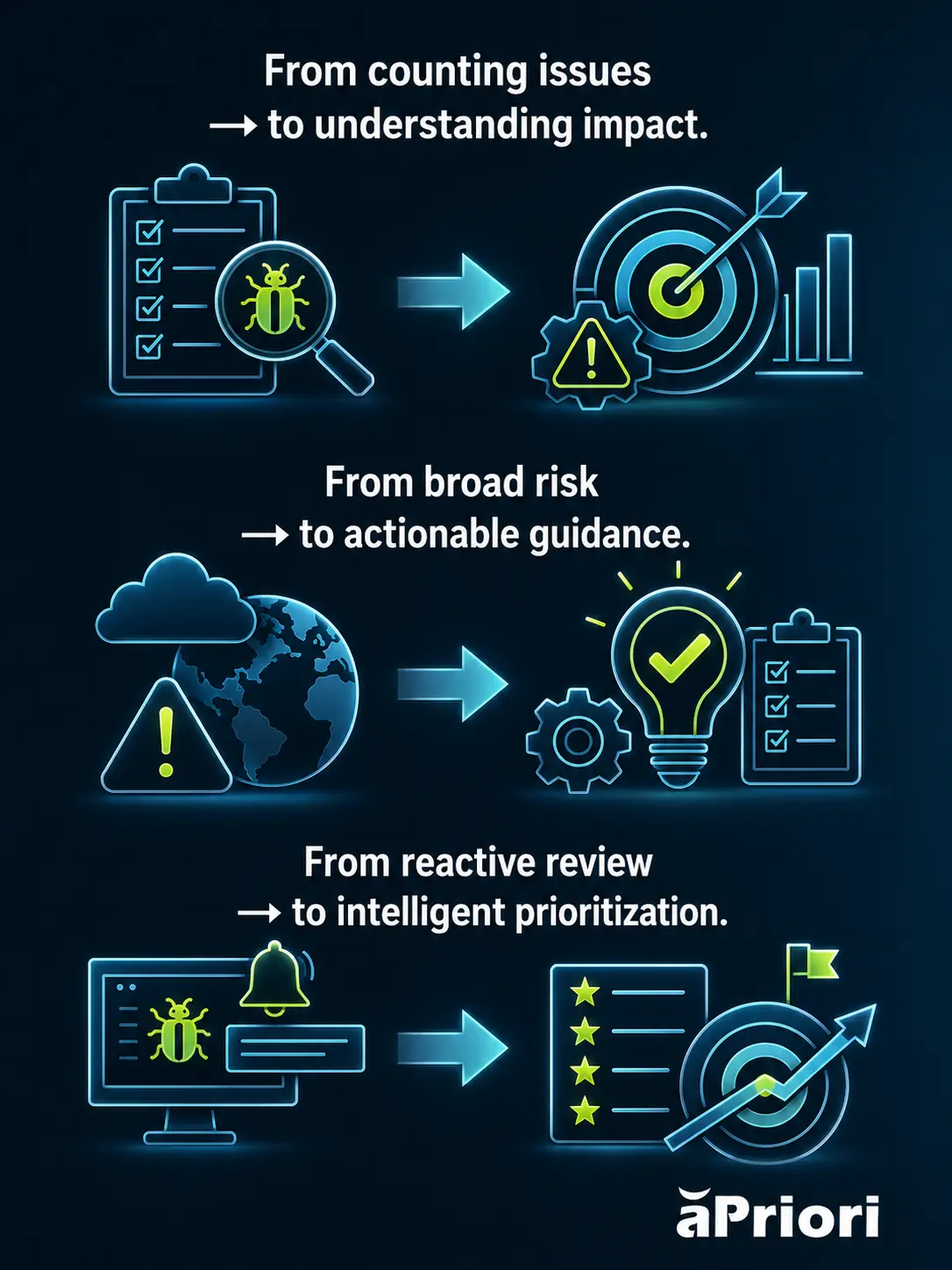
CAD tools will always be essential to the design process—but they cannot tell an engineer whether a part can be manufactured, which features are cost drivers, or how to prioritize design changes.
aPriori’s new DFM Severity assessment closes that gap, giving teams the clarity they need to design and optimize manufacturable, cost-effective parts—faster and with far greater confidence.





Are Your Design Engineering Precision And Speed At Odds?
Our Quantified DFM webinar gives design engineers and manufacturers the ability to quantify DFM rather than measure it subjectively.Access The Webinar