Resources Hub


Indirect and Direct Manufacturing Costs: Where Profitability Is Quietly Won—or Lost

Lily Thomas
— April 7, 2026
Listen to this Article
1×
00:00
00:00
Key Takeaways:
- Today’s challenges, including geopolitical issues, inflation, and high interest rates, are having an impact on indirect and direct manufacturing costs
- The National Association of Manufacturers (NAM) notes that surveyed manufacturers report trade uncertainty as one of their top business concerns, rising from 56% in Q4 2024 to 78% in Q3 2025
- aPriori can help forecast expenses and identify where to cut indirect and direct costs to boost profitability
The Full Article:
According to McKinsey, indirect operations account for 8%-12% of a manufacturer’s total operating costs. Deloitte’s 2026 Manufacturing Industry Outlook notes that the cost of intermediate materials and components in manufacturing on the Producer Price Index (PPI) increased from 234.3 in November 2024 to 241.8 in July 2025.
Increased prices, such as those for energy, overhead costs, manufacturing equipment, materials, services, and labor, necessitate optimizing both indirect and direct manufacturing costs. Doing so ensures resilience, profitability, and growth.
Examples of Indirect and Direct Manufacturing Costs
Indirect and direct costs are not one and the same. Note the differences between them in the following chart:
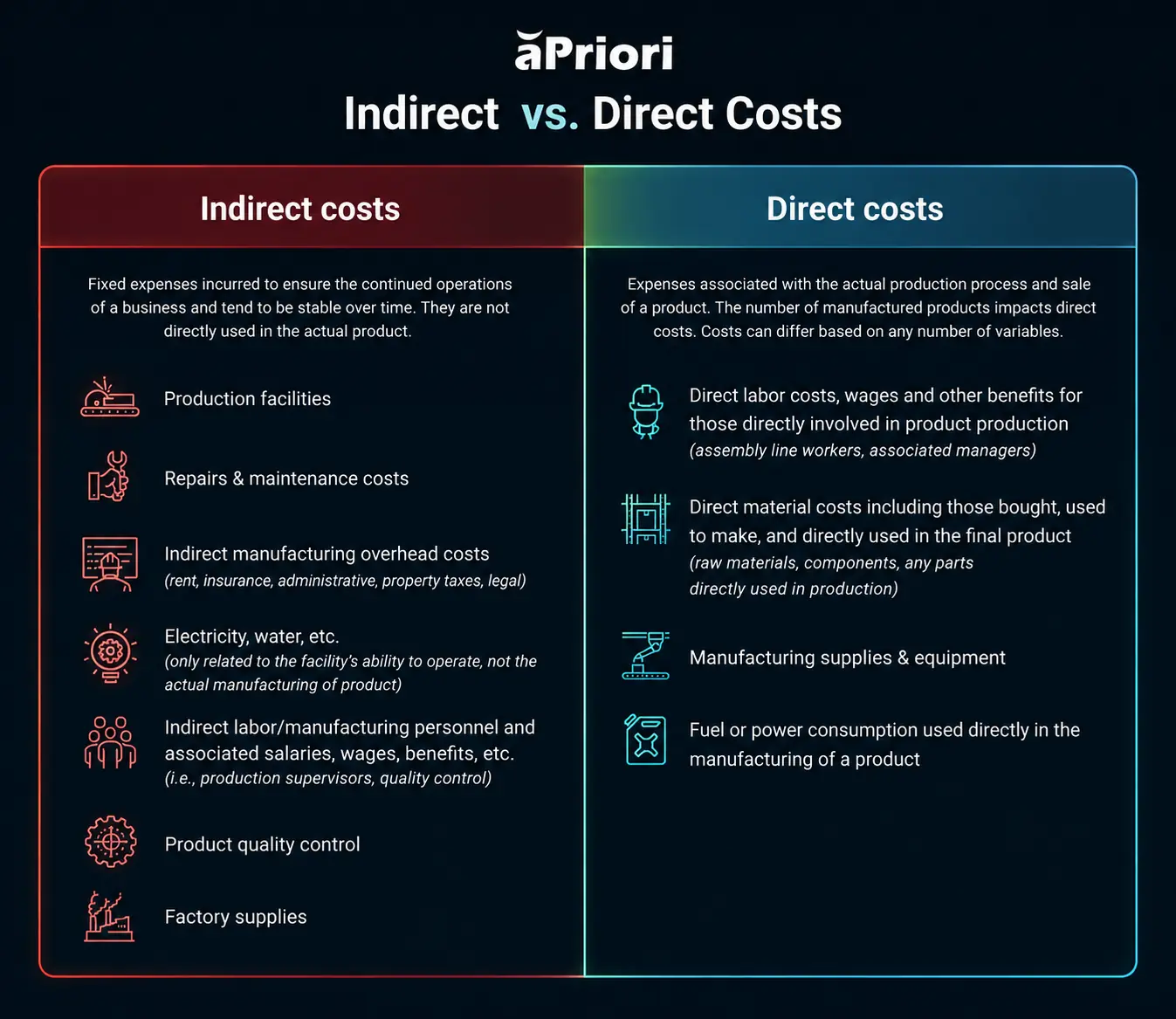
Direct costs, including direct labor costs, are involved with the actual production cycle, while indirect costs, including indirect labor and indirect material costs, keep a business operating.
Reduce supplier costs by comparing prices in 93 geographic regions with our Regional Data Libraries.
How Indirect and Direct Manufacturing Costs Impact Profitability
The above indirect costs are unavoidable for most businesses. Moreover, they make up a significant portion of businesses’ total manufacturing costs since they are essential to ensuring efficiency in day-to-day manufacturing operations. As a result, it is critical that manufacturers optimize the bottom line.
Manufacturers are focusing on optimizing efficiency and minimizing costs through technology upgrades and supply chain changes, which influence both direct and indirect costs.
With ever-increasing prices across materials, services, and labor, as well as tariffs, it is imperative that manufacturers use a digital manufacturing solution. It can identify cost outliers and ensure indirect and direct cost optimization, strengthening resiliency and improving profitability.
Without the right manufacturing intelligence solution, many manufacturers might be cutting into their profits. The good news is that aPriori accounts for these indirect and direct manufacturing costs and can facilitate better business decisions.
aPriori Identifies the Cost Outliers to Improve Profitability
Manufacturers are under pressure to get to market quickly and ensure profitability. Additionally, they must address challenges such as supply chain issues, tariffs, and labor shortages.
The NAM Outlook Survey also reveals that:
- A majority of manufacturers (80.3%) report paying tariffs on imported manufacturing inputs since the start of 2025
- Tariffs are impacting manufacturers of all sizes, with 8%small and medium-sized manufacturers with less than 500 employees paying tariffs on inputs this year—alongside 97% of large.
- When it comes to hiring needs, 1% of respondents cite skilled production workers (technicians, welders, and machinists), 60.1% point to core production workers (operators, assemblers, and packaging), and 33.5% say they need highly-skilled, degreed workers (scientists, researchers, and engineers). The need for skilled workers also drives higher labor costs.
aPriori’s manufacturing intelligence can support their efforts and help mitigate many of these challenges. Here are a few ways aPriori identifies and reduces direct and indirect manufacturing costs:
- Product Quality and Cost Control: Product quality in the design stage greatly influences cost. If manufacturability issues are not caught before a design is released, then an engineering change order might be required. Even worse, a defect can cause delivery delays. A digital factory can detect defects prior to production in the physical factory. Product development teams can create lower-cost products without sacrificing quality during the design process. aPriori provides real-time, data-driven insights into cost, design, and manufacturability, accounting for various materials, manufacturing processes, regional factories, and annual production volume. Unnecessary features can be removed, and design flaws detected. The most cost-effective materials can be used. Time-to-market, product quality control issues, and manufacturing overhead costs are reduced. These Design to Value (DTV) and Design to Cost (DTC) methodologies enable manufacturers to deliver profitable products, maximizing the value of new products to end users. Hear how CNH’s entire engineering team uses aPriori to design profitable products faster and leverage DTC at scale.
- Supply Chains: Supply chain management, in particular, reducing requests for quotes (RFQs) times (an indirect cost), can greatly impact the bottom line. This is especially true in the procurement of raw materials used in products (a direct cost). Depending on the size of the organization and the number of parts needed, RFQs can be time-consuming and labor-intensive. How can you ensure you get the best price for raw materials? aPriori helps navigate supply chain challenges and management. Moreover, aPriori helps manufacturers mitigate tariffs by providing detailed visibility into the true cost of producing parts across different regions, enabling smarter sourcing decisions. By simulating manufacturing processes and costs—including labor, materials, and production complexity—teams can compare whether it’s cheaper to reshore, nearshore, or switch suppliers. It also identifies design changes that reduce production costs, helping offset tariff impacts without sacrificing quality. Additionally, aPriori highlights cost drivers and inefficiencies, so manufacturers can optimize parts before production and avoid unnecessary expenses. Together, this allows companies to proactively adapt their supply chains and reduce the financial impact of tariffs. See how Thompson Aero Seating found 68% cost savings on their most expensive parts.
- Labor shortages: According to Deloitte, US manufacturing is expected to have 2.1 million unfilled positions by 2030. Woodward uses aPriori to assess the cost and manufacturability of parts, matching open opportunities within the supplier’s digital factory. Working closely with strategic suppliers enables Woodward to tap into their expertise, control costs, and ensure access to critical materials and components – especially for new product development. Woodward went from a 10-week to a 1-week supplier lead time, mitigating labor shortages and moving from five people quoting supplier prices to one person. Consequently, productivity improves. The McKinsey article substantiates this, noting that streamlining processes and tasks can result in a 5 to 15% increase in productivity. Watch Jill Snyder, Director of Cost Engineering, highlight how aPriori streamlined product development and helped quickly onboard new and existing employees in should costing.
The Digital Thread is Key to Reducing Costs and Boosting the Bottom Line
Understanding and anticipating both indirect and direct manufacturing costs can help you forecast total expenses more accurately and determine where they can be reduced. Identifying reductions with the right manufacturing insights solution can be transformative for an organization, reducing inefficiencies and streamlining processes.
Manufacturers who recognize this untapped potential and leverage manufacturing insights gain myriad benefits. Most importantly, they reduce costs. They also mitigate supply chain and labor challenges, improve cash flow and profit margins, and strengthen their resilience and competitiveness in the marketplace.




How Are You Ensuring You Can Reduce Product Costs Efficiently?
Discover how Siemens Energy is optimizing aPriori in conjunction with its other integrated tools to achieve sustainability goals and become more cost-efficient in the wind turbine sector.Watch The Webinar